





Untangling Time on Venus
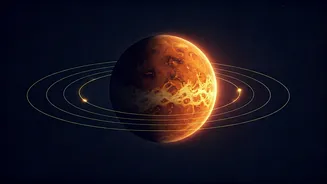
To understand this mind-bending statement, we first need to be clear about our terms. A ‘year’ is straightforward: it’s the time it takes for a planet to complete one full orbit around the Sun. For Venus, this journey takes about 225.5 Earth days. Now
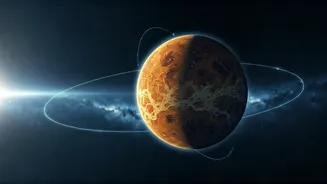
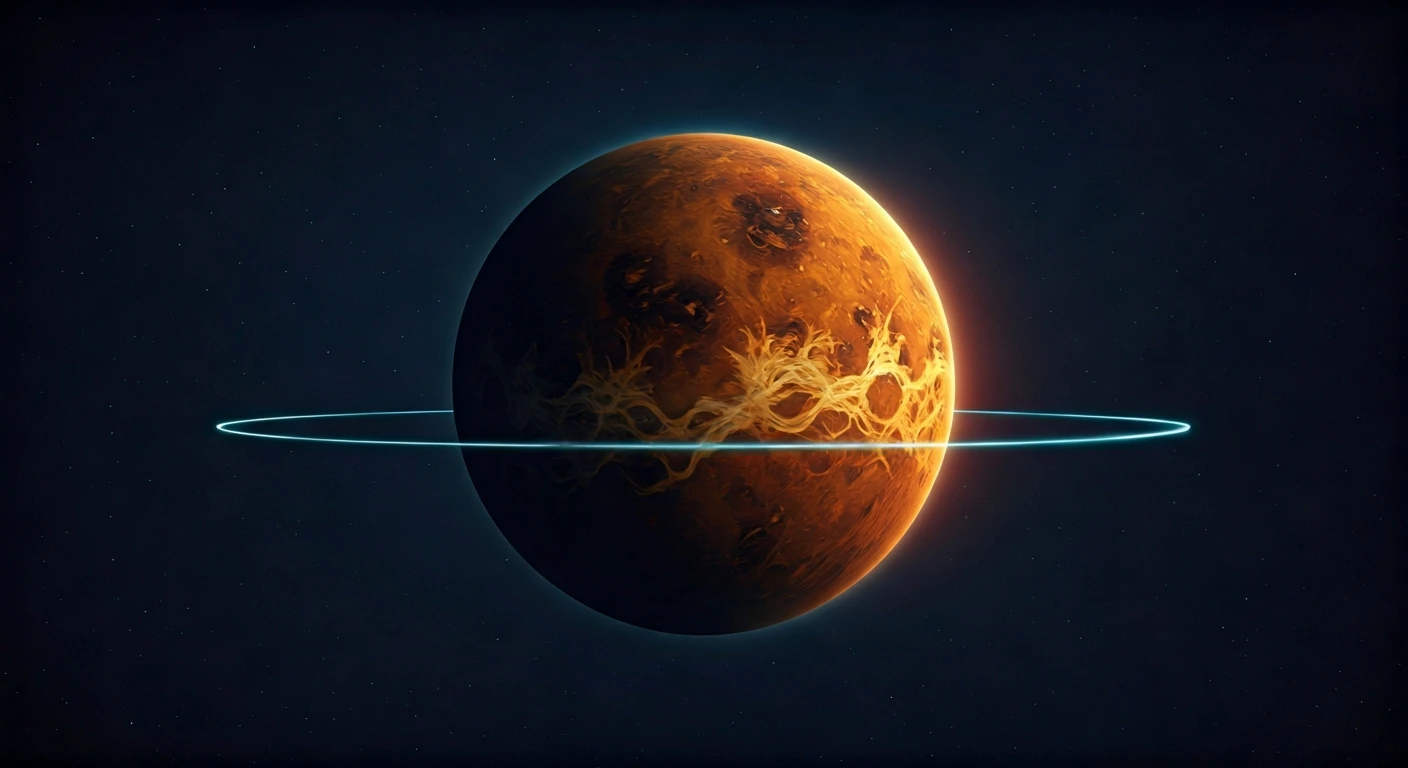
for the tricky part: the ‘day’. On Earth, we barely distinguish between the time it takes for our planet to spin 360 degrees (a sidereal day) and the time from one sunrise to the next (a solar day). On Venus, the difference is everything. A Venusian sidereal day—the time it takes for the planet to complete one full rotation on its axis—is an incredibly sluggish 243 Earth days. So, right there is the answer to the riddle: one full spin (243 days) takes longer than one full orbit (225.5 days). A day is, quite literally, longer than a year.
The Retrograde Rebel
The situation gets even stranger. Most planets in our solar system, including Earth, spin on their axis in a counter-clockwise direction (prograde). If you looked down from above the Sun's north pole, you'd see them all orbiting and spinning in the same direction. But not Venus. Venus spins clockwise, a motion known as retrograde rotation. It is the rebel of the solar system, spinning backwards and incredibly slowly. This combination of a slow, backward spin and a relatively quick orbit creates another bizarre temporal effect. While a single rotation takes 243 Earth days, the time from one sunrise to the next—a solar day—is ‘only’ about 117 Earth days long. This happens because as Venus slowly spins backwards, it is also moving forward in its orbit, causing the Sun to ‘catch up’ in the sky much faster.
Why Is Venus So Weird?
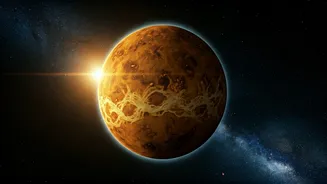
Scientists aren't entirely sure why Venus spins so slowly and backwards. The two leading theories point to a violent past or a long, drawn-out atmospheric war. One hypothesis suggests that early in its history, Venus was struck by a massive planet-sized object that was powerful enough to not just tilt its axis but completely reverse its spin. The impact would have bled off nearly all its rotational energy, leaving it with the languid rotation we see today. Another compelling theory involves Venus's crushingly thick atmosphere. Some models suggest that powerful atmospheric tides, created by solar heating, have acted as a brake over billions of years. This friction between the solid planet and its soupy, dense atmosphere could have gradually slowed its rotation and may have even been enough to eventually flip it into a retrograde spin. It’s a planetary tug-of-war between the Sun’s gravity and the planet’s own atmosphere.
Consequences of a Slow Spin
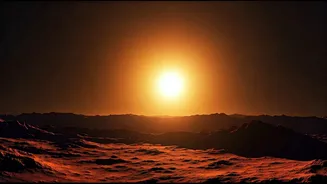
This lazy rotation has profound consequences for the planet. On Earth, our relatively rapid 24-hour spin helps distribute the Sun’s heat, creating the day-night temperature cycles we are familiar with. On Venus, with a single solar day lasting nearly four Earth months, one side of the planet bakes for an extended period while the other is plunged into a long night. You might expect this to create a massive temperature difference between the day and night sides, but Venus has another trick up its sleeve: its atmosphere. The atmosphere is so thick—about 90 times denser than Earth's—that it acts like a global blanket. Powerful winds, whipping around the planet much faster than the planet itself rotates, efficiently circulate heat. As a result, the temperature on Venus is a relatively uniform and hellish 465°C, day or night.