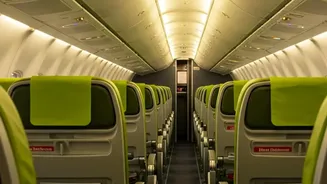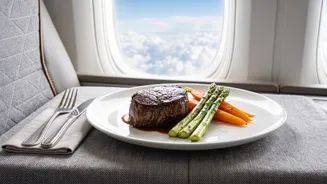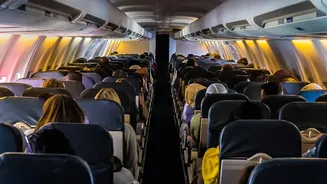








If you’ve ever found your in-flight meal disappointingly bland, you’re not alone. But before you blame the airline's chef, science suggests the real culprit is the airplane cabin itself. The unique environment at 35,000 feet changes how we taste.
The Air Up There
The first
major factor altering your sense of taste is the combination of low pressure and low humidity inside the cabin. At cruising altitude, the cabin is pressurized to an equivalent of about 6,000 to 8,000 feet. This thinner air slightly reduces blood oxygen saturation, which can dull your sensory receptors. Compounding this is the extremely dry air. Cabin humidity often drops below 12-20%, a level drier than most deserts. This aridity dries out the mucous membranes in your nose, which is a problem because your sense of smell is responsible for about 80% of what we perceive as flavour. When your nasal passages can't function properly, your ability to detect complex aromas in food is significantly diminished, making everything taste much flatter.
The Science of In-Flight Taste
German research organization, the Fraunhofer Institute, conducted extensive studies for Lufthansa by simulating airplane cabin conditions in a special low-pressure chamber. Their findings were clear: the environment significantly impacts our perception of key tastes. The research showed that sensitivity to salty and sweet flavours drops by as much as 30% at cruising altitude. This means a dish that is perfectly seasoned on the ground will taste under-seasoned in the air. However, not all tastes are affected equally. The perception of sour, bitter, and spicy flavours remains largely stable. This is why acidic dressings or spicy curries often seem more appealing on a flight.
A Surprising Factor: Noise
It's not just the air pressure and humidity; the constant drone of the jet engines also plays a role. The background noise in a typical aircraft cabin can reach around 85 decibels, similar to city traffic. Research from Cornell University and other institutions has found that loud noise can suppress the perception of sweetness. Interestingly, the same studies revealed that while sweetness is muted, the perception of umami—the fifth basic taste known for its savoury, brothy quality—is actually enhanced by loud noise. This explains the enduring popularity of tomato juice on flights; tomatoes are rich in the compounds that produce umami, making the juice taste more robust and satisfying in a noisy cabin than it might on the ground.
How Airlines Adapt the Menu
Airline caterers are well aware of these sensory challenges and have developed strategies to compensate. They often increase the amount of salt and spices in their recipes to ensure the food has enough flavour to punch through the dulled senses of passengers. Knowing that umami is stable or even enhanced, chefs frequently design menus that lean on umami-rich ingredients like tomatoes, mushrooms, parmesan cheese, and soy sauce. This is why you will often find meals like pasta with tomato sauce, mushroom-based dishes, and Asian-inspired recipes on in_flight menus. They also have to contend with the fact that all meals are cooked on the ground, then blast_chilled and reheated in convection ovens on board, a process that further alters texture and taste.