




A Personal, Pressurised Spacecraft
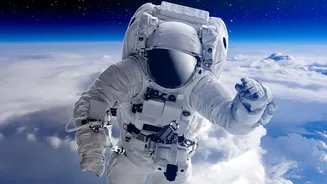
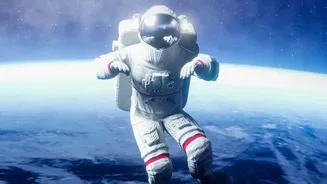
The correct term for a spacesuit used for spacewalks is an Extravehicular Mobility Unit, or EMU. It's a marvel of engineering designed to do one primary job: keep the astronaut alive in a place where life cannot exist. The most immediate threat in space is the vacuum.
Here on Earth, the atmosphere provides a constant pressure of about 14.7 pounds per square inch that our bodies are accustomed to. Without that external pressure, the gases and liquids within our bodies would rapidly expand and boil, a catastrophic event that would be fatal in seconds. The EMU creates a pressurized bubble around the astronaut, typically at around 4.3 psi of pure oxygen, which is enough to keep bodily fluids in a liquid state and prevent the body from expanding.
A Breathable Atmosphere and Water to Drink
Humans need a steady supply of oxygen to survive, and in the vacuum of space, there is none. The EMU's Portable Life Support System (PLSS), the 'backpack' portion of the suit, contains tanks of pure oxygen for breathing. But just supplying oxygen isn't enough. As an astronaut breathes, they exhale carbon dioxide. A buildup of CO2 is toxic, so the PLSS actively scrubs it from the air inside the suit, keeping the atmosphere breathable. The suit also provides drinking water through a special in-suit drink bag, as spacewalks can be long and physically demanding.
Surviving Extreme Temperatures
Space has no air to distribute heat, leading to wild temperature swings. An object in direct sunlight can bake at 121°C (250°F), while in shadow, it can plunge to a frigid -121°C (-250°F). To manage this, the suit is made of many layers. The outer layers are white to reflect the intense heat of the sun. Underneath are layers of insulating material, like Mylar, that function like a high-tech thermos to slow heat transfer. But astronauts also generate their own body heat while working. To prevent overheating, they wear a Liquid Cooling and Ventilation Garment underneath the main suit. This spandex-like undergarment has tubes of cool water circulating through it to draw excess heat away from the body, which is then radiated out into space.
An Armor Against Invisible Dangers
The suit also serves as a shield. Earth's atmosphere and magnetic field protect us from the most harmful radiation from the sun and deep space. An astronaut on a spacewalk is far more exposed. The suit's multiple layers and a special gold-lined visor on the helmet offer protection from damaging ultraviolet and particle radiation. Another threat comes from micrometeoroids. Even a particle as small as a grain of sand, travelling at over 27,000 kilometers per hour, can strike with the force of a bullet. To guard against this, the suit's outermost layer is a tough, puncture-resistant fabric woven from materials like Kevlar, Gore-Tex, and Nomex.
The Challenge of Working in a Balloon
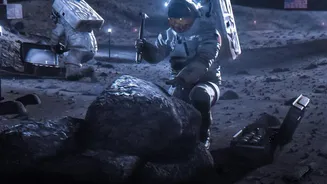
Designing a suit that provides all this protection while still allowing an astronaut to move and work is a huge engineering challenge. A pressurized suit naturally wants to be stiff, like an inflated balloon. Bending an arm or closing a hand requires fighting against that pressure, which can be exhausting. Modern suits use complex bearings at the joints—in the shoulders, waist, and legs—to give astronauts a greater range of motion. Gloves are particularly difficult, as they must protect the hands while allowing for enough dexterity to handle tools. This balance between protection and mobility is a central focus for engineers designing the next generation of suits for missions to the Moon and Mars, where astronauts will need to walk, crouch, and interact with a planetary surface.