

More Than Just a Solar Observatory
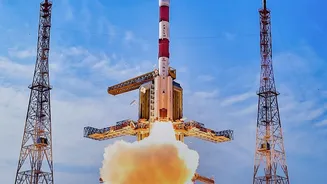
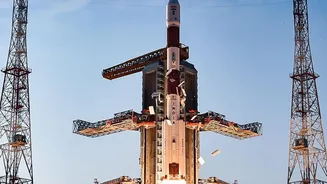
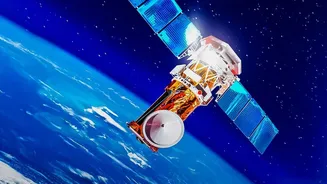
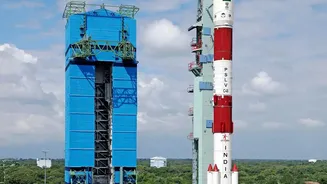
Launched in September 2023, Aditya-L1 is ISRO's pioneering effort to observe the Sun continuously. Stationed in a halo orbit at Lagrange Point 1 (L1), it has an uninterrupted view, free from eclipses or Earth's shadow. This allows its seven sophisticated
payloads to study the Sun's atmosphere, magnetic fields, and the solar wind in unprecedented detail. The mission is already helping to solve long-standing solar mysteries, such as why the Sun's outer atmosphere, the corona, is hundreds of times hotter than its surface. These fundamental discoveries are not just academic; they have profound practical implications for our technology-dependent world and for the safety of all future space missions.
The Crucial Science of Space Weather
A key objective of Aditya-L1 is to improve our ability to forecast 'space weather'. This refers to the constant stream of charged particles and radiation from the Sun, known as the solar wind, and violent events like Coronal Mass Ejections (CMEs) and solar flares. When directed at Earth, these solar storms can disrupt satellite communications, knock out power grids, and endanger astronauts. In its first year, Aditya-L1 has already demonstrated its value, providing a comprehensive analysis of dozens of powerful X-class flares and capturing the first-ever spectroscopic signatures of a CME's onset. Recent findings, published in prestigious journals, show the mission is detecting small, precursor brightenings that occur hours before a major flare, a crucial step toward reliable forecasting. This early warning system is vital for protecting India's space assets, worth over 50,000 crore, and for safeguarding future astronauts.
Building Confidence for Interplanetary Travel
Successfully placing and maintaining a spacecraft in a complex halo orbit has been a massive technological achievement for ISRO. It has validated in-house flight dynamics systems and demonstrated precise deep-space navigation capabilities. This proven expertise is a direct stepping stone for more ambitious missions. The data from Aditya-L1 is essential for planning future missions like Mangalyaan-2 (Mars Orbiter Mission-2) and Shukrayaan (a mission to Venus). Understanding the solar radiation environment is critical for designing spacecraft that can survive long journeys through deep space and for ensuring the safety of a future Indian space station and crewed missions like Gaganyaan. Put simply, knowing what the Sun is doing helps ISRO protect its astronauts and robotic explorers on their way to other worlds.
The Road to the Moon, Venus, and Beyond
Aditya-L1 is part of a larger, ambitious roadmap for Indian space exploration. The insights it provides are foundational for ISRO's next wave of missions. Plans are already in motion for Chandrayaan-4, a lunar sample-return mission slated for around 2028. Following that, India aims to launch its Bharatiya Antariksha Station by 2035 and land an Indian astronaut on the Moon by 2040. These are not standalone goals but part of an integrated strategy. The success of Aditya-L1, both scientifically and technologically, provides the crucial data and, just as importantly, the confidence to pursue these monumental objectives. It proves India has the capability to design, launch, and manage complex, long-duration deep-space missions, placing it in an elite group of space-faring nations.