



The Sun’s Fiery Temper
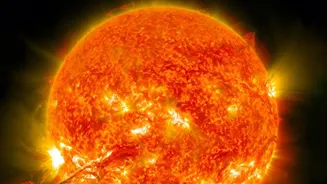
Imagine the Sun's powerful magnetic fields as massive, tangled elastic bands. Sometimes, these fields, especially around dark patches called sunspots, cross over and snap. This sudden release of stored magnetic energy creates a solar flare—a gigantic
explosion on the Sun's surface. In just a few minutes, this event heats solar material to millions of degrees and sends a massive burst of radiation hurtling into space at the speed of light. This radiation spans the entire electromagnetic spectrum, from radio waves to powerful X-rays and gamma rays. Because this energy travels so fast, we on Earth see the flare and feel its initial effects at almost the same moment, roughly eight minutes after it happens.
A, B, C, M, X: Not All Flares Are Equal
Scientists classify solar flares based on their X-ray brightness, using a letter system: A, B, C, M, and X. Much like the Richter scale for earthquakes, each letter represents a tenfold increase in energy. 'A' class flares are the smallest, barely above the Sun's normal background radiation levels. 'C' class flares are also small and typically have few noticeable effects on Earth. 'M' class flares are medium-sized and can cause brief radio blackouts, especially in Earth's polar regions. 'X' class flares are the largest and most powerful explosions in our solar system. An X-class flare can produce as much energy as a billion hydrogen bombs and has the potential to cause significant disruptions if aimed at Earth. Within each class, a number from 1 to 9 gives a finer scale of its strength, though X-flares can go even higher than 9.
Flares vs. Coronal Mass Ejections (CMEs)
Solar flares are often confused with Coronal Mass Ejections (CMEs), but they are different phenomena that can occur together. A flare is an intense burst of light and radiation. A CME, on the other hand, is a massive cloud of magnetised solar gas, or plasma, that gets hurled into space. Think of it this way: a flare is the bright flash, while a CME is the cannonball. The radiation from a flare reaches Earth in about eight minutes. A CME travels much slower, taking anywhere from 15 hours to several days to arrive. The strongest flares are almost always accompanied by a CME, and it's this combination that can cause the most significant space weather events.
How Solar Flares Affect Earth
While the Earth's atmosphere protects us from the harmful radiation of a solar flare, our technology is not so lucky. The immediate effect comes from the X-rays and ultraviolet radiation, which travel at light speed. This radiation can ionise Earth's upper atmosphere, causing disruptions to high-frequency radio communications on the sunlit side of the planet. This can impact aviation and maritime navigation systems that rely on these signals. When a CME follows a flare, it can trigger a geomagnetic storm. These storms can induce powerful electrical currents in our power grids, potentially causing widespread blackouts. They can also interfere with GPS signals, reducing their accuracy or causing a complete loss of signal.
Satellites and The Aurora's Glow
Satellites orbiting outside our protective atmosphere are particularly vulnerable. The radiation can damage their electronics and solar panels, while the increased atmospheric drag from a geomagnetic storm can cause their orbits to decay. However, there is a beautiful side effect to all this solar chaos. When the charged particles from a CME interact with Earth's magnetic field and atmosphere, especially near the poles, they create spectacular light displays known as the aurora borealis (Northern Lights) and aurora australis (Southern Lights). The more intense the solar storm, the farther from the poles these breathtaking auroras can be seen.