


Beyond the Spice Rack
When we think of Indian cuisine, our minds often leap to a vibrant palette of spices—turmeric, cumin, coriander, cardamom. We celebrate the complex layering of heat, sourness, sweetness, and umami. Yet, to focus only on taste is to watch a play with the sound
off. Indian cooking is a full-sensory production where texture is a lead actor, deliberately cast to surprise, delight, and engage. From the crackle of a freshly fried papadum to the yielding softness of a gulab jamun, texture provides the narrative arc of a meal. It’s the difference between merely eating and truly experiencing your food. This focus isn’t accidental; it’s a foundational principle, turning a simple dish into a dynamic event.
The Symphony of Contrasts
The genius of Indian textural play lies in its love for contrast. A single dish, or even a single bite, is often a carefully constructed collision of opposites. Consider the humble dahi vada. Soft, spongy lentil dumplings are soaked until they’re impossibly tender. They are then submerged in cool, creamy yogurt. But the performance doesn't end there. The dish is garnished with a shower of crunchy sev (fried chickpea flour noodles), crisp boondi, and jewel-like pomegranate seeds that pop with juicy sweetness. Every spoonful offers a journey: the initial creaminess of the yogurt gives way to the soft vada, punctuated by moments of sharp crunch. It’s this interplay—the dialogue between soft and crisp, smooth and coarse, liquid and solid—that creates culinary theatre. This principle is everywhere, from the crunchy nuts in a rich, velvety korma to the crisp vegetable bits in a soft paratha filling.
The Final Act: The Tadka
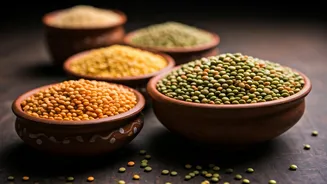
Nowhere is the dramatic role of texture more apparent than in the tadka, also known as chhaunk or vaghar. This finishing technique is a masterstroke of Indian cooking. Spices like mustard seeds, cumin seeds, dried red chillies, and lentils are sizzled in hot ghee or oil until they pop, crackle, and release their essential aromas. This fragrant, fiery mixture is then poured over a finished dish—most often a dal, soup, or vegetable curry—just before serving. The effect is instantaneous and transformative. A simple, homogenous lentil soup is suddenly alive. You hear the sizzle as the tadka hits the dal. You smell the toasted spices. And most importantly, you feel it. The mustard seeds pop in your mouth, the fried lentils offer a delightful crunch, and the curry leaves add a brittle crispness, elevating a one-note dish into a multi-textured composition.
A Full Production on a Single Plate
If a single dish is a scene, then the Indian thali is the full three-act play. A thali is a platter featuring a complete meal in small bowls (katoris), arranged around a central portion of rice or bread. It’s a microcosm of the entire philosophy. On one plate, you might find a liquid dal, a chunky vegetable sabzi, a creamy raita, a crisp papad, a tangy pickle, and a soft, pliable roti. The act of eating a thali is an interactive performance. You, the diner, are the director. You might scoop up some chunky vegetables with a piece of soft roti, or mix the liquid dal with fluffy rice before adding a crunch of papad on top. Each combination creates a new textural experience. It encourages you to play, to mix and match, and to be mindful of how the different elements interact. The thali isn't just a meal; it's an education in balance and contrast.
From Street Food to Celebrations
This textural obsession is democratic, found in every corner of Indian gastronomy. Take street food. Pani puri is a masterclass in texture: the fragile, crispy sphere shatters to release a flood of spicy, tangy water and a soft filling of potatoes and chickpeas. Bhel puri is a riot of puffed rice, crunchy sev, raw onions, and soft potatoes, all bound by tangy tamarind chutney. It’s a dish that must be eaten immediately, before the crunch surrenders to the wetness. Even festive sweets aren't spared this treatment. A creamy kheer (rice pudding) is often studded with chewy raisins and crunchy almonds. A flaky, layered soan papdi dissolves on the tongue, a testament to the textural magic woven by a skilled halwai (confectioner). Each dish tells a story, and texture is its most compelling narrator.