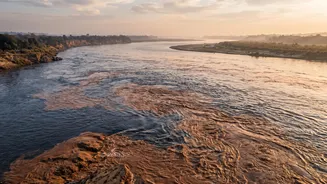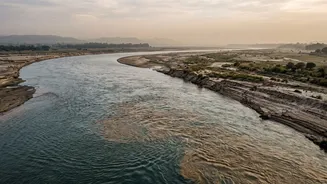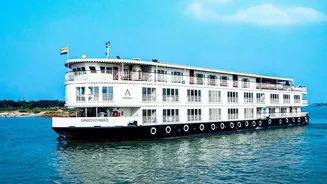








For millions across India and Bangladesh, the Ganges is more than a river; it's a lifeline. At the heart of its shared journey lies a critical structure, the Farakka Barrage, and a landmark agreement now facing its most crucial test.
A Monument of Contention and Cooperation
Located in West Bengal,
just kilometres from the Bangladesh border, the Farakka Barrage was commissioned by India in 1975. Its primary purpose was strategic: to divert water into the Hooghly River to flush out silt and preserve the navigability of the Kolkata Port, a vital commercial artery for eastern India. However, this diversion immediately raised concerns for downstream Bangladesh. By altering the river's natural flow, the barrage affects agriculture, fisheries, and drinking water supplies for tens of millions of people who depend on the river, which they call the Padma. This set the stage for decades of complex negotiations over a resource fundamental to both nations.
The 1996 Ganges Water Treaty
After years of interim arrangements, a breakthrough occurred on December 12, 1996, with the signing of the Ganges Water Sharing Treaty. Valid for 30 years, it was hailed as a diplomatic success. The pact established a detailed formula for sharing water at Farakka during the critical dry season, which runs from January 1 to May 31 each year. The sharing is calculated in 10-day periods. The formula varies based on the total flow, but it established a framework of predictability. For instance, if the flow is 70,000 cubic feet per second (cusecs) or less, the two countries share it equally. A joint committee was also formed to monitor flows at both Farakka and downstream at Bangladesh's Hardinge Bridge, ensuring transparency.
A Treaty at a Critical Crossroads
The 30-year treaty is set to expire in December 2026, placing it at the centre of current India-Bangladesh relations. Its operational phase for the year has already concluded, as the sharing formula only applies until May 31. Now, the focus is on what comes next. Bangladesh's government has formed a high-level committee to negotiate a renewal, signalling it may seek revised terms. A key demand is the inclusion of a 'guarantee clause' to secure minimum water flows, a feature of a previous 1977 agreement that was absent in the 1996 pact.
High Stakes for Both Nations
For Bangladesh, a lower-riparian nation, a predictable flow is essential to combat salinity intrusion in its coastal delta, sustain its vast agricultural sector, and protect riverine ecosystems and livelihoods. The lack of a renewed treaty could create significant uncertainty. For India, the stakes are also high. The water diverted at Farakka remains important for the Kolkata Port and serves the needs of West Bengal. Moreover, states like Bihar have also voiced their own increasing water demands, adding another layer of complexity to India's negotiating position. The entire issue is handled by the Joint Rivers Commission (JRC), a bilateral body designed for such matters, but high-level political engagement is seen as essential for a breakthrough.
The Path to a New Agreement
Officials from both countries have confirmed that discussions are underway through the JRC, but no formal high_level meetings on the renewal have been announced as of early November 2026. An invitation has been extended for Bangladesh's Prime Minister, Tarique Rahman, to visit India, a trip that is widely seen as a necessary step for renewing a treaty originally signed at the prime ministerial level. Experts suggest a renewed pact should consider modern challenges like climate change, which affects river flows, and adopt a more comprehensive basin_wide approach rather than focusing solely on volumetric sharing at a single point. The unresolved issue of the Teesta River, another of the 54 shared rivers, also looms in the background of the broader water diplomacy between the two neighbours.