


A Storm from 150 Million Kilometres Away
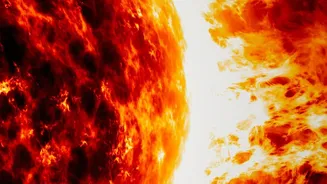
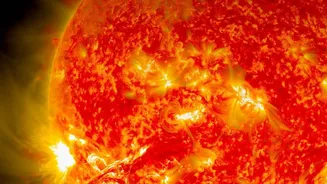
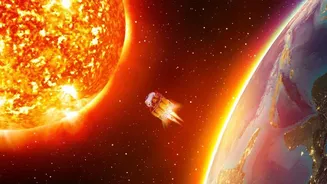
Unlike a terrestrial hurricane, space weather isn't about wind and rain. It refers to the volatile conditions in space driven by our Sun. The Sun constantly emits a stream of charged particles called the solar wind. But sometimes, it unleashes much more
powerful outbursts. These include solar flares, which are intense bursts of radiation, and coronal mass ejections (CMEs), which are giant clouds of solar plasma and magnetic fields hurled into space. When these events are directed at Earth, they can have significant consequences. While our planet's magnetic field protects us from the worst of it, strong solar storms can still buffet this shield, creating disruptions that ripple down to the surface and affect our technology.
Our Fragile Digital World
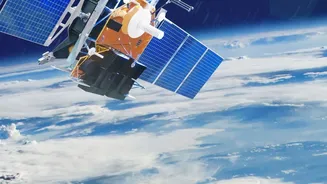
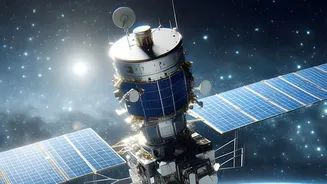
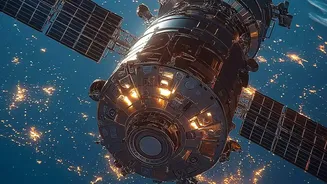
The primary victims of space weather are satellites and power grids. Satellites orbiting outside Earth's protective atmosphere are directly exposed to energetic particles from solar storms. This radiation can damage their sensitive electronics, degrade solar panels, and even cause 'phantom commands' that disrupt their operations. In severe cases, the heated and expanding atmosphere can increase drag on satellites in low-Earth orbit, causing them to lose altitude. On the ground, the danger comes from geomagnetically induced currents (GICs). A powerful solar storm can cause Earth’s magnetic field to fluctuate wildly, inducing powerful, uncontrolled DC currents in long conductors on the surface—like power lines and pipelines. These rogue currents can flow into electrical grids and overload high-voltage transformers, potentially leading to widespread and long-lasting blackouts.
The Space Weather Forecasters
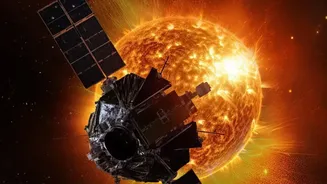
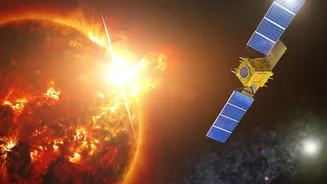
To protect against these threats, we first need to see them coming. This is the job of space weather forecasters at agencies like the USA's NOAA Space Weather Prediction Center (SWPC) and organisations that use their data. They operate 24/7, using a network of ground-based and space-based observatories to monitor the Sun. Satellites provide the frontline defense. Spacecraft like the Solar and Heliospheric Observatory (SOHO) are positioned at a special point between the Earth and Sun called Lagrange Point 1 (L1), about 1.5 million kilometres away. This gives them an uninterrupted view of the Sun, allowing them to spot CMEs as they erupt. In India, ISRO's Aditya-L1 mission, also positioned at L1, plays a crucial role in providing real-time data on solar activities and their effect on space weather. By analysing the size, speed, and magnetic orientation of a CME, forecasters can predict if it will hit Earth and how severe its impact might be.
From Prediction to Protection
A good forecast is only useful if it leads to action. A typical CME takes one to three days to travel from the Sun to Earth, providing a critical window to prepare. Once the SWPC or another national agency issues a watch, warning, or alert, industries can take protective measures. Satellite operators can power down non-essential components or reorient their spacecraft to protect sensitive electronics from incoming radiation. Electric grid operators are a key user of these forecasts. With advance warning, they can proactively manage the grid to make it more resilient. This might involve reducing the load on certain transformers, redirecting power flows, or even temporarily disconnecting parts of the grid to prevent a cascading failure. Airlines also pay close attention, as intense solar radiation storms can disrupt high-frequency radio communications, forcing them to reroute flights away from polar regions.