





The Sun’s Temper and Our Tech
We often think of space as empty and calm, but the Sun frequently sends powerful bursts of energy and particles hurtling towards Earth. These events, known as space weather, include solar flares and coronal mass ejections (CMEs). While Earth's magnetic
field protects us on the ground, our vital infrastructure in orbit is highly vulnerable. A strong solar storm can be catastrophic for satellites. It can fry sensitive electronics, degrade solar panels that power them, and even increase atmospheric drag, causing them to fall out of orbit. Given that India has space assets worth thousands of crores, protecting this infrastructure is a national priority.
India’s Watchful Eye: Aditya-L1
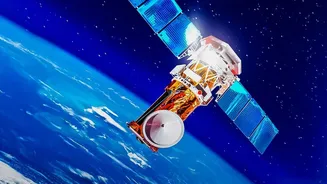
Enter Aditya-L1, the Indian Space Research Organisation's (ISRO) pioneering mission to study the Sun. It is strategically positioned at Lagrange Point 1 (L1), about 1.5 million kilometres from Earth. This unique spot allows the spacecraft to have a continuous, uninterrupted view of the Sun, without being blocked by the Earth or Moon. Think of it as a permanent solar watchtower. Its primary job is to act as an early warning system, gathering data on solar activities that could lead to dangerous space weather.
Gathering Clues Before the Storm
Aditya-L1 is equipped with seven sophisticated instruments, each with a specific job. Four of these payloads observe the Sun directly, while the other three measure the space environment at the L1 point itself. Key instruments like the Visible Emission Line Coronagraph (VELC) and the Solar Ultraviolet Imaging Telescope (SUIT) watch for the tell-tale signs of an impending storm. They capture high-resolution images of the Sun's atmosphere—the photosphere, chromosphere, and the super-hot corona—tracking the origin and development of CMEs and solar flares. Recent findings have even shown that the spacecraft can detect small brightenings that occur hours before a major flare, acting as a crucial precursor signal.
From Raw Data to Actionable Forecasts
The real magic happens when this data is fed into predictive space weather models. Previously, forecasts relied on satellites closer to Earth, offering very little warning time. Aditya-L1 changes the game completely. By observing a solar eruption as it leaves the Sun, it gives scientists and satellite operators hours, or even days, of advance notice. This 'in-situ' data on the solar wind—the stream of charged particles constantly flowing from the Sun—allows models to predict when a storm will arrive and how intense it will be with far greater accuracy. This lead time is everything.
A Shield for Our Satellites
This early warning is not just a scientific curiosity; it has profound real-world consequences. With a reliable forecast from Aditya-L1's data, satellite operators can take defensive measures. They can temporarily shut down non-essential and sensitive electronic systems to prevent them from being fried by a surge of energetic particles. They can also reorient satellites to protect their main components or perform small orbital manoeuvres to counteract the effects of increased atmospheric drag. This proactive approach significantly enhances the operational lifespan and reliability of satellites that power our communication networks, navigation systems like GPS, and television broadcasting. Studies of past solar storms using Aditya-L1's data have already shown how turbulent regions can compress Earth's magnetic field and expose even geostationary satellites to harsh conditions, underscoring the need for such forecasts.