





The High-Speed Junkyard Above
For decades, every rocket launch and satellite deployment has left something behind. Today, low-Earth orbit is littered with everything from defunct satellites and spent rocket stages to tiny flecks of paint and metal shards from past collisions. More
than 27,000 pieces larger than a softball are tracked by networks on the ground. But the real number is far higher, with models estimating over a million objects larger than a centimeter. Each of these objects travels at speeds up to 28,000 km/h. At that velocity, even a small piece of debris can strike an operational satellite with catastrophic force, potentially triggering a chain reaction of collisions known as the Kessler Syndrome, which could render entire orbits unusable. To prevent this, space agencies and private companies are developing sophisticated technologies to actively remove the most dangerous pieces of junk.
Casting a Net in Zero Gravity
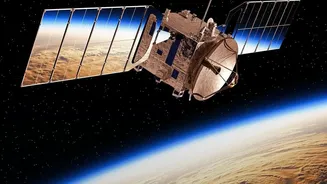
One of the leading methods for capturing uncooperative debris involves using nets and magnetic grappling systems. The Japanese company Astroscale is a pioneer in this field with its ELSA (End-of-Life Services by Astroscale) program. After a successful demonstration mission, the company is preparing for ELSA-M, which is slated to be the first commercial mission to remove a full-sized defunct satellite, planned for 2026. The concept is elegant. Future satellites will be launched with a pre-installed docking plate. When the satellite reaches the end of its life, Astroscale’s “servicer” spacecraft can rendezvous with it, and use a powerful magnet to securely attach to the plate. Once docked, the servicer acts like a tow truck, dragging the dead satellite into a lower orbit where it will burn up harmlessly in Earth's atmosphere. While nets were tested on the 2018 RemoveDEBRIS mission, the magnetic approach is seen as a safer option for targets that have been specially prepared for capture.
Zapping Debris with Light Beams
An even more futuristic approach involves using high-powered lasers. This contactless method, often called laser ablation, works by focusing a powerful laser beam onto a piece of debris from the ground or another spacecraft. The intense energy doesn't vaporize the object entirely. Instead, it heats a tiny spot on its surface, causing a small amount of material to burst outward as a jet of plasma. This jet acts like a tiny rocket thruster, nudging the debris and altering its trajectory. With repeated pulses, the object’s orbit can be gradually lowered until atmospheric drag takes over and pulls it down to burn up. While incredibly promising for dealing with smaller debris that is too numerous to capture one-by-one, laser removal is still largely in the theoretical and experimental stages. Researchers are working to perfect the technique, ensuring the laser nudges the debris without accidentally breaking it into more, smaller pieces.
Harpoons, Claws, and Robotic Arms
Magnetic nets and lasers are not the only tools in the orbital cleanup kit. The European Space Agency (ESA) is backing the ClearSpace-1 mission, which will use a chaser satellite with four robotic arms to grab and de-orbit an old piece of Vega rocket hardware. Described as a 'space claw', the craft will rendezvous with its target, embrace it, and then perform a controlled descent to burn up in the atmosphere. The mission, now planned for 2028, is considered a vital demonstration of capturing debris that wasn't designed to be caught. Other concepts that have been successfully tested include harpoons, which were demonstrated on the RemoveDEBRIS mission by piercing a target panel. These varied approaches show there is no one-size-fits-all solution; the best method depends on the target's size, shape, and stability.