





In the vast, dark corners of our galaxy, NASA's new eye in the sky is peering into the atmospheres of cosmic oddities. The SPHEREx telescope has detected the chemical fingerprints of water and methane on 'failed stars', a major astronomical clue.
A New Cosmic Cartographer
NASA's
SPHEREx telescope, which stands for Spectro-Photometer for the History of the Universe, Epoch of Reionization, and Ices Explorer, is on a monumental quest. Launched in 2025, its primary two-year mission is to create an unprecedented map of the entire sky. Unlike telescopes that focus on small patches of space in high detail, SPHEREx is a survey instrument, capturing the big picture. Every six months, it scans the whole sky in near-infrared light, which is invisible to the human eye but perfect for spotting the chemical signatures of molecules and distant galaxies. Using a technique called spectroscopy, it breaks light down into 102 different colour bands, creating a 3D map of the cosmos that will help scientists understand everything from the first moments after the Big Bang to the prevalence of life's ingredients in our own galaxy. The detection of molecules in the atmospheres of brown dwarfs is an exciting early result from this ambitious project.
What Exactly Are 'Failed Stars'?
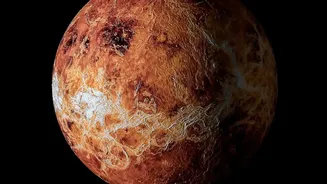
The subjects of this new discovery are brown dwarfs, often called 'failed stars'. These celestial objects occupy a mysterious middle ground between the largest gas giant planets, like Jupiter, and the smallest stars. They form from collapsing clouds of gas and dust, just like stars do. However, they never accumulate enough mass—typically falling between 13 and 80 times the mass of Jupiter—to ignite and sustain the nuclear fusion of hydrogen in their cores, the process that makes stars shine brightly for billions of years. While they aren't massive enough for full-blown fusion, the most massive brown dwarfs can briefly fuse a heavier form of hydrogen called deuterium. Lacking a permanent internal engine, they simply cool and fade over their lifetimes, glowing faintly from the residual heat of their formation. This makes them dim, difficult to spot, and fascinating subjects for understanding where the line between planet and star truly lies.
A Chemical Fingerprint in the Darkness
The recent findings from SPHEREx focused on a sample of nearby brown dwarfs, revealing their chemically rich atmospheres. By analysing the infrared light from these objects, scientists identified the distinct absorption patterns—or chemical fingerprints—of several key molecules, including water (H2O) and methane (CH4), as well as carbon monoxide and carbon dioxide. This isn't the first time such molecules have been found on brown dwarfs, but SPHEREx's power lies in its ability to survey many of them, capturing a wide range of temperatures and atmospheric conditions. This allows for a more comprehensive understanding of how their atmospheric chemistry evolves as they age and cool. Researchers noted that as a brown dwarf's temperature drops, its carbon tends to be found in methane rather than carbon monoxide, a key transitional phase the telescope is uniquely equipped to study.
Why Water and Methane Matter
Finding water and methane on these isolated worlds is significant for several reasons. Firstly, it helps refine our models of atmospheric physics. Brown dwarf atmospheres can feature clouds made of molten minerals like silicates and iron. As the object cools, these clouds can sink, changing the chemistry of the visible atmosphere. The SPHEREx data shows that current models are good at predicting the general chemical makeup but struggle with the specifics of this transition, indicating that the atmospheric dynamics are more complex than previously thought. Secondly, it deepens our understanding of the cosmic inventory of life's building blocks. While these brown dwarfs are not considered habitable themselves—due to their cooling nature and lack of a stable star—studying the molecules in their atmospheres provides crucial data on how and where elements like carbon, hydrogen, and oxygen combine in the galaxy. This information helps scientists trace the origins of water and organic molecules that could one day seed new planets.
What Comes Next for SPHEREx?
The analysis of brown dwarfs is just one part of SPHEREx's broader mission. The telescope continues its daily work of scanning the sky, building its cosmic map that will ultimately chart the positions of over 450 million galaxies. This primary dataset will be a treasure trove for cosmologists studying the rapid expansion of the early universe. For planetary scientists and astrobiologists, the data on brown dwarfs is a valuable bonus. Scientists are in the process of analysing thousands more brown dwarf observations from the survey. These future results will provide a much larger sample size, allowing them to see the full range of atmospheric diversity and better understand the lifecycle of these enigmatic objects that straddle the definition of star and planet.