





The Challenge with Traditional Forecasts
Agriculture is the backbone of the Indian economy, yet it remains highly vulnerable to climatic shifts. Traditional weather forecasts, while helpful, often lack the precision and long-term outlook that farmers desperately need. A forecast for a large
region is of limited use to a farmer whose crops depend on conditions in their specific cluster of fields. Short-range predictions of 2-3 days don't provide enough time to make significant operational changes, such as altering crop choice or scheduling labour for the entire planting season. This uncertainty often forces farmers into a low-risk, low-return cycle, discouraging investment in higher-yield crops or more efficient practices because the financial risk from a sudden weather event is too great.
How AI Changes the Forecasting Game
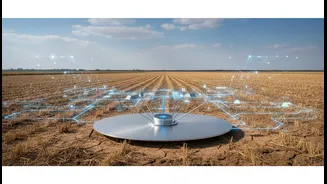
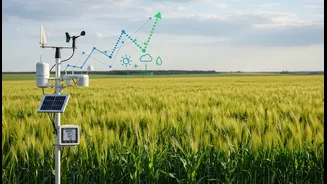
Artificial intelligence models approach forecasting differently. Instead of relying solely on complex physics-based simulations, which are computationally expensive, AI systems learn from vast amounts of historical data. By analysing decades of weather patterns, satellite imagery, and ground sensor data, AI can identify subtle trends and correlations that traditional models might miss. This allows AI to generate forecasts that are not only more accurate but also more granular and longer-range—often extending up to four weeks or more with growing confidence. This capability to provide hyperlocal predictions, sometimes down to a one-kilometre resolution, is a paradigm shift for agricultural planning.
The Power of Planning Ahead
What does an extra two or three weeks of lead time mean for a farmer? It means everything. A reliable long-range forecast for the monsoon's arrival can inform the most critical decision of the season: when to sow. Planting too early before the rains can cause seeds to fail, while planting too late can shorten the growing season and reduce yields. With advanced notice, farmers can select the crop varieties best suited for the expected conditions, deciding between water-intensive crops or drought-tolerant alternatives. It allows for better planning of irrigation schedules, fertiliser application to avoid runoff, and organisation of labour and machinery, ultimately saving money and boosting productivity. In 2025, for example, an AI model successfully predicted a stall in the Indian monsoon, and this information was sent via SMS to 38 million farmers, allowing them to adjust their planting schedules accordingly.
AI in Action Across India
This technology is no longer theoretical. In May 2026, the Indian government launched AI-powered weather forecasting systems to provide hyperlocal predictions to farmers. One system, aimed at 16 states, delivers weekly forecasts on the monsoon's progress up to four weeks in advance. These advisories are translated into practical guidance and sent directly to millions of farmers through SMS and voice messages. The initiative, developed by the India Meteorological Department (IMD) and other institutions, marks a significant step in using advanced technology to enhance disaster preparedness and agricultural planning on a national scale. A pilot program in Uttar Pradesh is even testing rainfall forecasts with a 1km resolution up to ten days in advance.
Hurdles on the Path to Adoption
Despite the immense potential, widespread adoption of AI in Indian agriculture faces challenges. Access to reliable, high-quality data at the local level is crucial for training effective AI models. Many rural areas still lack the robust digital infrastructure needed for seamless data collection and dissemination. Furthermore, there is the human element: building trust in new technology, overcoming digital literacy gaps, and ensuring the solutions are affordable and accessible for smallholder farmers are critical hurdles. Making the information not just available but also comprehensible and actionable for every farmer is the final, essential link in the chain.