




A Natural Laboratory in the Sky
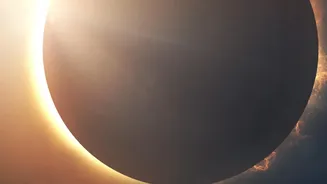
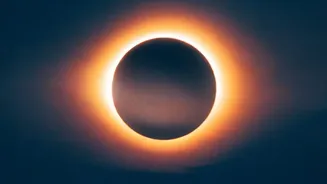
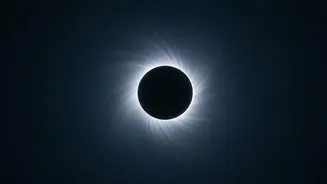
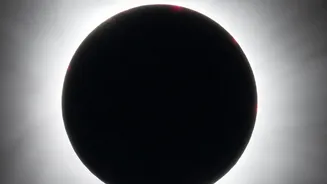
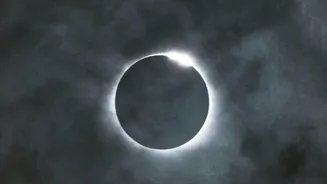
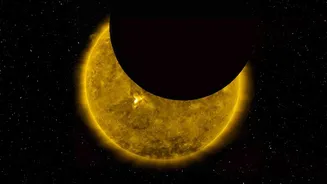
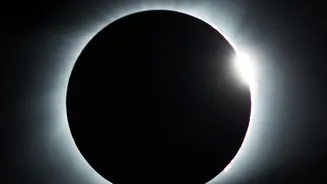
A total solar eclipse is more than just a beautiful cosmic alignment; it transforms the sky into a unique laboratory. The Moon, by perfectly blocking the Sun's intensely bright face, reveals the faint, ethereal outer atmosphere called the corona. While
scientists have instruments called coronagraphs to mimic this effect, they struggle to reveal the innermost part of the corona, where many critical solar processes originate. The natural perfection of an eclipse provides an unparalleled view, allowing for observations that can unlock secrets about our star and its far-reaching influence.
Unmasking the Sun's Fiery Crown
The primary goal for many scientists during an eclipse is to study the corona. One of its biggest mysteries is the coronal heating problem: why is this outer atmosphere hundreds of times hotter than the Sun's surface below? By capturing high-resolution images during the 2026 eclipse, researchers hope to better understand how energy is transferred and how the corona gets super-heated to millions of degrees. These observations are crucial for understanding solar wind, the stream of charged particles the Sun constantly ejects. This wind defines the edge of our solar system and can disrupt satellites and power grids on Earth, a phenomenon known as space weather.
Chasing the Shadow for Clues
To maximize their precious minutes of data collection, scientists will go to great lengths. NASA plans to fly its WB-57 high-altitude research aircraft along the eclipse path over Greenland, Iceland, and Spain. Equipped with a suite of advanced cameras in its nose cone, the jet will chase the Moon's shadow, capturing rapid changes in the corona's structure. At the same time, the NASA-supported Nationwide Eclipse Ballooning Project will release dozens of balloons from Iceland and Spain. These will study how Earth's atmosphere, particularly the boundary layer closest to the surface, reacts to the sudden drop in sunlight and temperature.
Echoes of Scientific History
Eclipses have a rich history of enabling major scientific breakthroughs. During an 1868 eclipse in India, an astronomer discovered a spectral line in the Sun's chromosphere that did not correspond to any known element, leading to the discovery of helium, named after the Greek sun god Helios. In 1919, an eclipse expedition provided the first experimental proof for Albert Einstein's theory of general relativity by observing how the Sun's gravity bends the light from distant stars. The 2026 eclipse continues this legacy, with student teams in Spain planning to replicate this famous experiment.
The Eclipse's Impact on Earth
The Moon's shadow doesn't just affect the sky; it has a noticeable impact on Earth. The sudden darkness causes a rapid drop in temperature and light, influencing our planet’s upper atmosphere. The ionosphere, a region of charged particles vital for radio communications, is dramatically altered as the Sun's energy is temporarily cut off. Studying this rapid 'switching off' and 'on' gives scientists a real-time model for how the ionosphere behaves, providing insights into how it affects GPS and communication systems. Researchers will also observe how the unusual daylight conditions affect animal and plant life, adding another layer to the scientific importance of this celestial event.