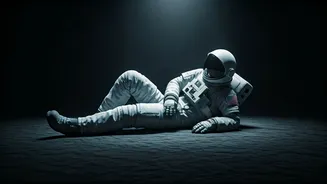









An Environment of Extremes
To understand the spacesuit, you first have to appreciate the sheer hostility of its working environment. Space isn't just empty; it's a vacuum with no atmosphere to scatter sunlight or hold onto heat. When an astronaut is in direct sunlight, they are
being bombarded with unfiltered solar radiation, capable of heating surfaces to a scorching 250 degrees Fahrenheit. But just a few feet away, in shadow, the temperature plummets to a bone-chilling minus 250 degrees. That’s a 500-degree swing. An astronaut's body needs to be kept within a tiny, stable temperature range to survive. The suit they wear, officially known as an Extravehicular Mobility Unit (EMU), is less an article of clothing and more a personal, human-shaped spacecraft designed to manage these impossible conditions.
The Simple Physics of White
Here's where the color comes in. Think back to a simple, Earth-bound experience: on a hot summer day, you’d rather wear a white t-shirt than a black one. The same principle applies in space, but the stakes are infinitely higher. White is the most reflective color, meaning it bounces the maximum amount of thermal radiation away from the astronaut. Dark colors absorb light energy and convert it into heat—a fatal design flaw in an environment where you’re trying to shed the sun’s intense energy. By making the outermost layer of the suit a brilliant white, NASA engineers created a passive thermal control system. It reflects the sun’s heat before it can be absorbed, preventing the astronaut from cooking inside their own suit. It's the simplest and most effective solution to one of the biggest thermal challenges of working in orbit.
A Multi-Layered Defense System
While the white outer shell is the first line of defense, it’s just one part of a complex, multi-layered system. The outer layer itself is a specialized, rugged fabric called Ortho-Fabric. This is a blend of materials including Gore-Tex (for waterproofing), Kevlar (for puncture and tear resistance), and Nomex (for fire resistance). It’s designed to be tough enough to withstand impacts from tiny, fast-moving micrometeoroids and orbital debris. Beneath this protective skin are about 14 more layers, each with a specific job. Several layers of aluminized Mylar, shiny like aluminum foil, act as further insulation, reflecting heat away. Next comes the suit's pressure bladder, an inflatable layer that maintains the internal pressure needed to keep an astronaut's bodily fluids from boiling in the vacuum of space. Closest to the skin is a liquid cooling and ventilation garment—essentially a set of long underwear threaded with tiny tubes of circulating water that pulls excess body heat away and keeps the astronaut comfortable.
More Than Just Sunblock
The suit’s design protects against more than just temperature. The same solar radiation that creates extreme heat also includes dangerous levels of ultraviolet (UV) radiation. The suit's layers, along with the gold-lined visor on the helmet, are specifically designed to block these harmful rays. That gold coating is particularly effective at reflecting infrared and UV light while still allowing visible light to pass through, so the astronaut can see clearly without being blinded or burned. Ultimately, the white color is the most visible part of a sophisticated design philosophy. It's a reminder that in the unforgiving world of space exploration, function always dictates form. Nothing is done for aesthetics; every single element, from the color of the fabric to the number of layers, is a carefully calculated answer to a question of survival.