





The Old Way: A World of Complex Physics
For decades, weather forecasting has been the domain of supercomputers running Numerical Weather Prediction (NWP) models. These systems work by dividing the globe into a massive 3D grid and using the laws of physics—like fluid dynamics and thermodynamics—to
calculate how conditions will evolve from one moment to the next. This approach has become remarkably good, with accuracy improving by about one day per decade. However, it comes with significant drawbacks. These physics-based simulations are incredibly complex and computationally expensive, requiring hours of processing time on some of the world's most powerful computers to generate a single forecast. This high cost in both time and energy has created a natural ceiling on how quickly forecasts can be updated and how many scenarios can be explored.
AI Enters the Picture: Learning from the Past
Artificial intelligence models take a fundamentally different approach. Instead of simulating physics from scratch, they are trained on vast archives of historical weather data—decades of past observations and model outputs. By analysing this data, AI systems like Google's GraphCast, Huawei's Pangu-Weather, and NVIDIA's FourCastNet learn to recognise complex patterns and relationships in the atmosphere. They essentially learn which initial weather states tend to lead to specific future outcomes. Once trained, these models can produce a highly detailed 10-day global forecast in under a minute on a single high-end processor, a task that can take traditional NWP models hours on a supercomputer. This leap in efficiency is what experts are calling a revolution in meteorology.
The Twin Advantages: Unprecedented Speed and Accuracy
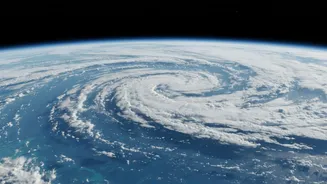
The most significant benefit of AI is the staggering increase in speed. What once took hours now takes minutes, allowing forecasters to run many more simulations, known as ensembles, to better gauge the range of possible outcomes and communicate uncertainty. This speed does not come at the expense of quality. In fact, leading AI models are now consistently matching or even outperforming the best traditional systems in medium-range forecasting. For example, Google's GraphCast proved more accurate than the industry's gold-standard model on over 90% of variables tested. These AI models have shown particular promise in predicting the paths of tropical cyclones, sometimes days earlier than conventional methods.
A Hybrid Future, Not an AI Takeover
Despite these impressive results, scientists are clear that AI is not a silver bullet that will make human meteorologists obsolete. Instead, the consensus points toward a hybrid future where AI works alongside traditional physics-based models. Each system has unique strengths. Traditional models are still superior at understanding the underlying physics and can be more reliable for predicting unprecedented extreme events that fall outside the historical data AI was trained on. A recent study noted that AI models can sometimes underestimate the intensity of record-breaking heatwaves or cold spells. By combining the pattern-recognition speed of AI with the physical grounding of NWP models, forecasters get the best of both worlds: faster guidance, a better understanding of probabilities, and a human expert to interpret the results and make the final call.
What This Means for India
For a country like India, which is acutely vulnerable to extreme weather, this technological leap holds immense promise. The ability to generate faster, more accurate, and more localized forecasts could be a game-changer for managing the monsoon, predicting the trajectory and intensity of cyclones in the Bay of Bengal and Arabian Sea, and issuing timely warnings for deadly heatwaves and flood events. The reduced computational cost also makes this advanced technology more accessible. National and regional meteorological agencies could run more sophisticated local forecasts without needing massive supercomputing infrastructure, providing farmers, disaster management authorities, and the public with the critical information needed to protect lives and livelihoods.