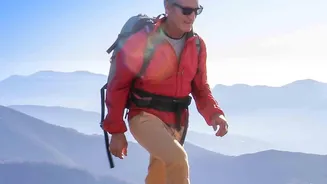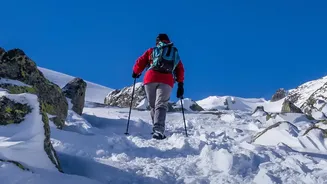









A hiker and a skateboarder move through the world with intense focus, yet their minds operate in completely different ways. One seeks stability and safety, the other creative opportunity. This is a look into their opposing mental states.
The Hiker’s Defensive Gaze
For a hiker, the
environment is a set of pre-existing conditions to be safely navigated. Attentiveness is primarily defensive. The hiker's brain is constantly scanning the path ahead, looking for instability and potential hazards. Their focus is on anticipating problems: a loose rock, a slippery root system, a sudden change in gradient, or an unmarked turn in the trail. This requires a broad, forward-looking awareness. Research shows that hiking on uneven terrain requires 28% more energy than walking on a flat surface, not just because of the physical effort, but because the brain is constantly making subtle calculations to maintain balance and stability. The goal is to move through nature with minimal negative impact, both on oneself and the environment. Every obstacle—a fallen log, a stream crossing—is a problem to be solved efficiently and safely. The mental state is often meditative, a 'soft fascination' where the mind can wander while still being tethered to the rhythm of walking and the sensory details of the natural world.
The Skateboarder’s Creative Scan
In stark contrast, a skateboarder's attention is offensive and opportunistic. They don't just see the environment; they reinterpret it. A set of stairs isn't just for walking down, a concrete ledge isn't just a border, and a handrail isn't just for safety. For a skateboarder, these are all potential features for expressing creativity and technical skill. Their focus is intensely immediate, scanning the ground just ahead for the tiny cracks, pebbles, and surface texture changes that could mean the difference between landing a trick and falling. This has been described as a 'meta-geography' of the urban space, where the city is mapped not by its intended function but by its potential for skating. This constant, high-speed problem-solving and creative interpretation requires a different kind of cognitive load. It's less about long-term pathfinding and more about a rapid-fire calculus of speed, angle, balance, and timing.
Different Brains, Different Flow States
Both activities are powerful conduits for achieving a 'flow state', that feeling of being completely immersed in an activity where time seems to disappear. However, the triggers and quality of that state differ significantly. For a hiker, flow is often born from rhythmic movement and prolonged, gentle focus on the surrounding nature. It's a calmer, more reflective state that reduces stress and activates parts of the brain associated with self-reflection. For a skateboarder, flow is a high-arousal state born from a perfect match between a difficult challenge and the skater's skill. Landing a complex trick requires such absolute concentration that it effectively silences the brain's background chatter of worry and distraction. It’s an active, high-stakes meditation where any lapse in focus results in immediate failure. This process of overcoming fear and committing to a trick rewires the brain, building resilience and strengthening neural circuits related to balance and spatial awareness.
Obstacles as Problems vs. Possibilities
Ultimately, the core difference comes down to how each discipline treats an obstacle. A hiker sees a fallen tree on the path and their brain asks, 'What is the safest and most efficient way over or around this?' They are adapting to a challenge presented by nature. A skateboarder sees a set of stairs and their brain asks, 'What is the most creative and challenging thing I can do on this?' They are imposing their own will and imagination onto a man-made structure. The hiker negotiates the world as it is, while the skateboarder transforms the world into a canvas. One is a practice of mindful observation and endurance; the other is a practice of artistic subversion and explosive skill. Both require immense focus, but one looks for the path of least resistance, while the other actively seeks out the path of most invention.