


An Incomprehensible Distance
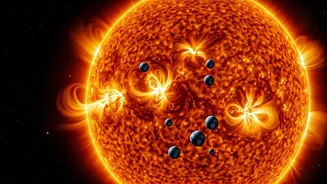
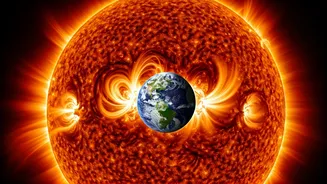
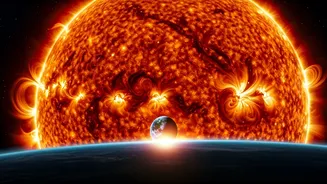
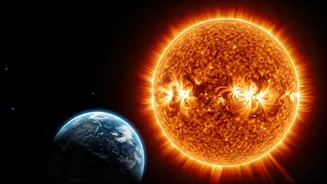
Our relationship with the sun feels immediate. It rises, we wake up. It shines, we feel warm. But this connection spans an almost unimaginable gulf. On average, the Earth orbits the sun at a distance of about 150 million kilometres. To put that into perspective,
if you were to drive a car at a constant 100 km/h, it would take you 177 years to reach the sun. Even a commercial jetliner would need more than 19 years to cover the distance. Space is defined by its emptiness and its scale, and the gap between us and our star is the first chapter in understanding this cosmic delay. It’s not just a big number; it’s a physical barrier that nothing, not even light, can cross instantly.
The Universe’s Ultimate Speed Limit
Light travels faster than anything else in the universe. In the vacuum of space, it zips along at a blistering 299,792 kilometres per second. It’s a speed so fast that a beam of light could circle the Earth more than seven times in a single second. Yet, even at this cosmic speed limit, the journey from the sun’s surface to our planet is not instantaneous. When you do the maths—dividing the 150-million-kilometre distance by the speed of light—you get a travel time of about 500 seconds. That translates to roughly 8 minutes and 20 seconds. Every single photon of light, every particle of warmth that lands on your skin, is a tiny time traveller that is over eight minutes old.
Living in the Sun’s Past
This eight-minute lag has a fascinating and slightly unsettling implication: we never see the sun as it is, but only as it was. The bright orb we see in our sky is always an eight-minute-old image. For all practical purposes on a normal day, this doesn't matter much. But consider a more dramatic, hypothetical scenario. If the sun were to suddenly and inexplicably vanish or stop shining, we on Earth would have no idea for a full 8 minutes and 20 seconds. We would continue to orbit an empty space, basking in the ghost-light of a star that was already gone. Then, all at once, daylight would cease, and the world would be plunged into the darkness and cold of deep space. It's a powerful reminder that our perception of the universe is always delayed, always a glimpse into the past.
A Cosmic Time Machine
This principle doesn't just apply to our sun. It's a fundamental aspect of how we observe the entire cosmos. The nearest star to our solar system, Proxima Centauri, is so far away that its light takes over four years to reach us. When we look at it, we are seeing the star as it was four years ago. The stars in the beloved Orion constellation are hundreds of light-years away; their light began its journey to our eyes before many of our great-grandparents were even born. The Andromeda Galaxy, the closest major galaxy to our own, is 2.5 million light-years away. The light we see from it tonight is 2.5 million years old, a faint echo from a time before modern humans walked the Earth. In essence, looking up at the night sky is the same as looking back in time. Telescopes are not just space-magnifiers; they are time machines.