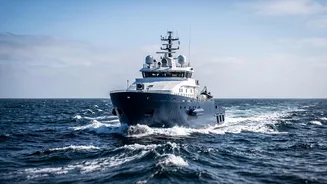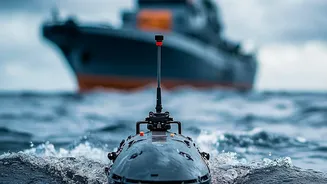







The vast, unpredictable ocean is the highway for over 80% of global trade. Now, researchers at IIT Madras are charting a new course for this colossal industry with SeaNav, a groundbreaking platform designed to make self-driving ships a reality.
A Digital Ocean for Autonomous Ships
Researchers
at the Indian Institute of Technology Madras have developed 'SeaNav', a sophisticated digital platform designed to test self-driving maritime navigation systems. This innovation creates a high-fidelity virtual environment, often called a 'digital twin', that simulates the complex conditions of the open sea. The primary challenge with autonomous ships isn't just building them; it's testing them. Real-world trials are expensive, time-consuming, and carry significant risks. SeaNav addresses this by allowing developers to test navigation algorithms in a realistic but completely safe, simulated world. This virtual testbed can replicate everything from ocean waves and vessel movements to dense ship traffic, creating a robust proving ground before a single physical vessel gets its hull wet.
How SeaNav Works
Developed by IIT Madras's Department of Ocean Engineering, SeaNav is built on the Unity3D engine, a powerful tool used for creating realistic simulations. It functions as a real-time simulator that creates a digital replica of the maritime world. The system has been calibrated using a benchmark model of a 320-meter-long tanker, ensuring that the results from the virtual tests closely mirror real-world shipping operations. By combining digital twin technology with Artificial Intelligence (AI), advanced sensor fusion, and even virtual reality, SeaNav creates an environment where both autonomous systems and human operators can be trained efficiently and safely. This allows for the rigorous validation of the complex AI and machine learning algorithms that are the 'brains' of any autonomous vessel, responsible for collision avoidance and navigation.
Enhancing Maritime Safety and Efficiency
The most immediate benefit of a platform like SeaNav is a massive leap in safety. By identifying and ironing out flaws in navigation software within a simulation, the risk of collisions or groundings during live deployment is significantly reduced. According to Dr. Suresh Rajendran, an Associate Professor at the Department of Ocean Engineering, IIT Madras, this technology can directly help strengthen safety at major Indian ports like Chennai, Mumbai, and Kochi. Beyond safety, the economic implications are huge. Smarter, AI-assisted navigation strategies can optimise routes, reduce fuel consumption, and lower carbon emissions. With the global shipping industry being a multi-trillion dollar enterprise, even minor efficiency gains can translate into massive cost savings and a smaller environmental footprint.
India's Voyage into a New Tech Frontier
The development of SeaNav is more than just an academic achievement; it's a strategic move that aligns with the Indian government's ambitious maritime goals, including the 'Sagarmala Programme' and 'Maritime India Vision 2030'. These initiatives emphasize the need for smart ports, digital technologies, and autonomous systems to make India a global maritime leader. While countries like Norway, Singapore, and Japan are also heavily invested in autonomous shipping, IIT Madras's work in this domain, including its Center for Marine Autonomous Systems (CMAS), signals India's growing ambition in this high-tech race. Furthermore, the multi-vessel simulation capability of SeaNav has promising applications beyond commercial shipping, including in coastal surveillance, search-and rescue operations, and maritime defence.