



What Makes Chandrayaan-4 Different?
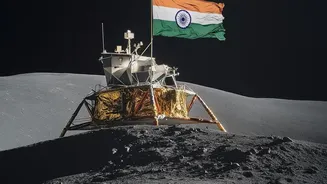
Chandrayaan-4 is a lunar sample-return mission, a major step up in complexity from its predecessors. While Chandrayaan-3 successfully demonstrated a soft landing, its components remained on the lunar surface. This new mission is designed to land, collect
up to three kilograms of lunar soil (regolith) and sub-surface material, and bring it safely back to Earth for study. If successful, India will join an exclusive club of nations — the United States, the former Soviet Union, and China — that have accomplished this challenging task. The mission is a crucial stepping stone for India's long-term goal of a manned lunar landing by 2040.
A Mission of Many Moving Parts
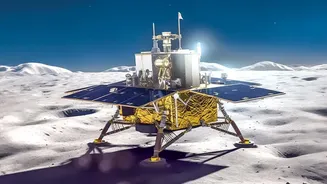
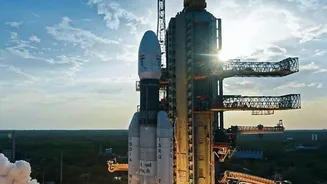
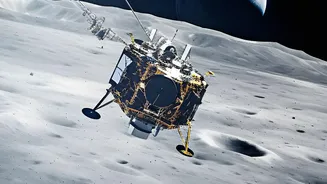
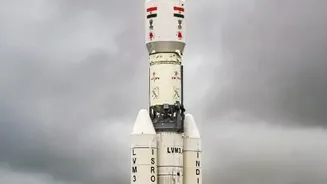
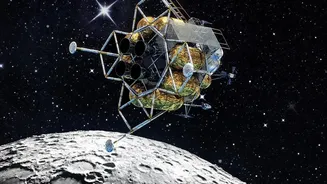
The complexity of Chandrayaan-4 requires an intricate, multi-module architecture that will be launched using two separate rockets, likely the heavy-lift LVM3. The mission consists of five main components: a Propulsion Module to travel to the Moon, a Descender Module for the landing, an Ascender Module to lift off from the Moon with the samples, a Transfer Module, and a Re-entry Module to bring the precious cargo back to Earth. This elaborate plan involves two separate launches and the first-ever attempt by ISRO to perform automated docking manoeuvres in both Earth and lunar orbits.
The Intricate Journey Home
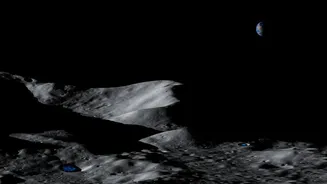
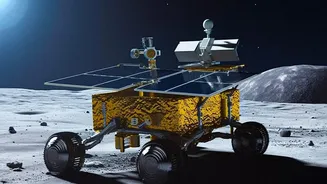
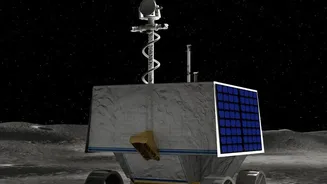
The mission sequence is a carefully choreographed celestial ballet. After landing near the lunar south pole, a robotic arm and a drill on the lander will collect surface and sub-surface samples. These will be sealed in a container on the Ascender Module, which then launches from the Moon's surface, leaving the lander behind. In lunar orbit, the Ascender will autonomously rendezvous and dock with the waiting Transfer and Re-entry modules. The sample container is transferred, and the return journey to Earth begins. Finally, the Re-entry module will separate and perform a high-speed plunge through Earth's atmosphere to deliver the samples.
The Scientific Prize: Lunar Soil and Ice
Bringing lunar samples back is a scientific game-changer. While rovers perform valuable in-situ analysis, studying samples in labs on Earth allows for far more detailed examination with powerful equipment that cannot be sent to space. The soil and rock from the Moon’s south pole region are of particular interest. This area is believed to contain water ice in permanently shadowed regions. Analyzing these samples could unlock secrets about the Moon's origin, the history of the solar system, and the availability of resources like water that would be essential for future human habitats on the Moon.
Overcoming Immense Technical Hurdles
Chandrayaan-4 is arguably ISRO's most challenging mission to date. It relies on several key technologies that India must master. These include launching a vehicle from another celestial body, performing autonomous rendezvous and docking far from Earth, and ensuring the sample return capsule can survive a fiery atmospheric re-entry. To mitigate some of these risks, ISRO has already conducted the Space Docking Experiment (SPADEX) to demonstrate the crucial docking technology in Earth's orbit. Furthermore, the mission requires an upgraded LVM3 rocket with a new semi-cryogenic engine, which is still under development. The mission is currently slated for a launch around 2028.