



A New Polygon at the Pole
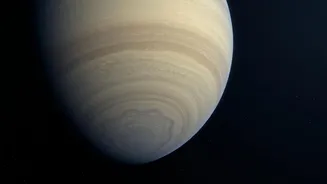
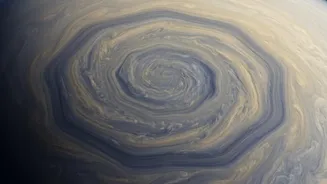
For decades, scientists have been fascinated by a massive, six-sided jet stream at Saturn's north pole, known as 'the hexagon'. Now, Hubble has confirmed a surprising new feature at the opposite end of the planet: a 10-sided atmospheric wave at the south
pole. This 'decagon' was first hinted at in 2023 but has become more defined in recent observations. Unlike the long-standing northern hexagon, which has been visible for over 40 years, this southern feature seems to be a recent and evolving phenomenon. Its sudden appearance has puzzled scientists, who are now eagerly watching to see how this giant atmospheric pattern develops and what it can teach us about the weather on gas giants.
The Return of the Ring Spokes
One of Saturn's most baffling features is its 'ring spokes' — transient, ghostly patterns that appear to move along the planet's iconic rings. First spotted by the Voyager 2 probe in 1981, these features have mystified astronomers for decades. New Hubble images show that 'spoke season' is now in full swing. These spokes are not permanent; they appear and disappear in a seasonal cycle, each season on Saturn lasting about seven Earth years. Their visibility is expected to peak around Saturn's equinox in May 2025. While they may look small, these features can stretch longer than the diameter of Earth.
Solving an Icy Mystery
So what causes these enigmatic spokes? The leading theory links them to Saturn's powerful magnetic field interacting with the solar wind. Scientists believe that during certain seasons, when the rings are tilted just right, charged particles from the sun may batter Saturn's magnetosphere. This interaction could generate electrostatic forces that levitate tiny ice and dust particles from the main rings, creating the visible spokes. However, no single theory perfectly explains their formation, and continued observation is needed to solve the puzzle. The ongoing Hubble observations provide a crucial long-term record, helping scientists track these changes over time.
A Legacy of Observation
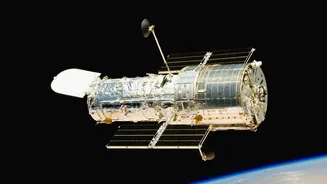
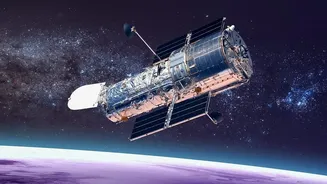
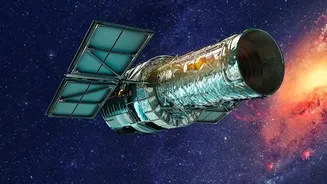
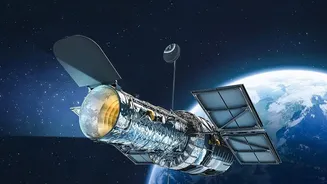
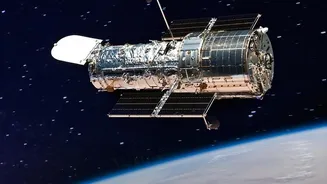
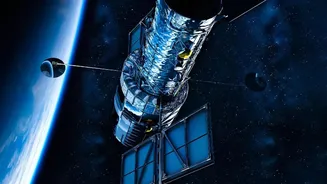
These new discoveries are part of the Outer Planet Atmospheres Legacy (OPAL) program, which uses the Hubble Space Telescope to conduct yearly check-ups on our solar system's outer planets. Since the Cassini mission ended in 2017, Hubble has been the primary tool for long-term monitoring of Saturn's atmospheric changes. This consistent, long-term observation allows astronomers to track subtle shifts in the planet's colourful cloud bands, monitor powerful storms, and understand its long seasonal cycles. By combining Hubble's visible-light data with infrared views from the James Webb Space Telescope, scientists can now get a more complete, three-dimensional understanding of Saturn's atmosphere, peeling back its layers like an onion.