




The Grand Ambition: What is Gaganyaan?
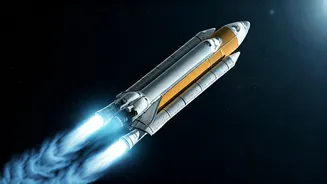
The Gaganyaan project is the Indian Space Research Organisation's (ISRO) ambitious mission to demonstrate human spaceflight capability by launching a crew of three astronauts into an orbit of 400 kilometres for a three-day mission and bringing them back
safely to Earth. Success would make India only the fourth country in the world—after Russia, the United States, and China—to have an independent capacity for human spaceflight. The program, approved in 2018, involves the development of critical technologies like a human-rated launch vehicle (HLVM3), life support systems, and a crew emergency escape system to ensure the mission is as safe as possible for the 'Gaganyatris' or 'Vyomanauts' on board.
Testing for Safety: The Air Drop Tests
Before astronauts can fly, every system must be proven flawless, especially the one that brings them home. A crucial part of this is the parachute-based deceleration system, designed to slow the Crew Module for a safe splashdown in the sea. To validate this, ISRO has been conducting a series of Integrated Air Drop Tests (IADT). In these tests, a simulated Crew Module is lifted by an Indian Air Force Chinook helicopter to a high altitude and dropped. A complex sequence of ten parachutes of different types then deploys to gradually reduce the module's speed to a safe landing velocity. Successful tests, like the IADT-02 conducted in April 2026, are a major step in qualifying the system for the actual mission.
The Uncrewed Rehearsals
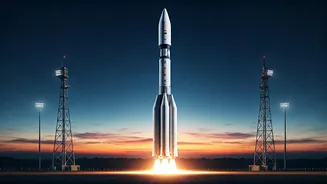
The next major chapter involves a series of uncrewed flights to test the entire system end-to-end. ISRO plans for at least two uncrewed missions before the first human flight. The first, designated Gaganyaan-1 (G1), is planned for the second half of 2026. These flights will use the powerful, human-rated LVM3 rocket to launch an unmanned Gaganyaan spacecraft into orbit. Every phase of a real mission will be simulated: the launch, orbital manoeuvres, re-entry into Earth's atmosphere, and the parachute-guided splashdown and recovery. These missions are the ultimate dress rehearsal, designed to verify that every component, from the rocket to the recovery teams, is ready for the crewed launch.
Meet Vyommitra: The 'Space Friend'
Aboard these uncrewed test flights will be a special passenger: Vyommitra. The name, derived from Sanskrit, means 'space friend'. Vyommitra is a half-humanoid robot, possessing a torso, head, and two arms, but no legs. Developed by ISRO, her purpose is to act as a stand-in for the human astronauts. She is engineered to mimic human functions, monitor the crew module's environment, operate switch panels, and even communicate with the ground station. By having Vyommitra on board, ISRO can gather vital data on how the life support and control systems function under real spaceflight conditions, validating crew safety protocols before a human is ever exposed to the risks.
Preparing the Astronauts
While the technology is being perfected, a select group of Indian Air Force test pilots are deep in training to become the nation's first astronauts. Four candidates—Group Captains Prasanth Balakrishnan Nair, Angad Pratap, Ajit Krishnan, and Wing Commander Shubhanshu Shukla—were announced in early 2024. Their rigorous training regimen has included stints in Russia, extensive coursework at ISRO's facility in Bengaluru, and even specialized studies in high-altitude environments to prepare for the mission's physiological and psychological demands. In a significant step, one of the astronauts is also gaining hands-on experience through a mission to the International Space Station, supported by Axiom Space.
The Road Ahead: Timeline to History
The path to India's first human spaceflight is a marathon of meticulous testing. Following the series of uncrewed flights featuring Vyommitra throughout 2026 and into 2027, ISRO will analyze vast amounts of data to make final adjustments. The crewed launch is now anticipated to take place in 2027 or 2028, provided all preceding tests are successful. Each successful test, from the parachute drops to the full orbital flights, builds confidence and brings India one step closer to achieving a long-held dream and cementing its status as a major global space power.