






Cosmic Lighthouses in the Dark
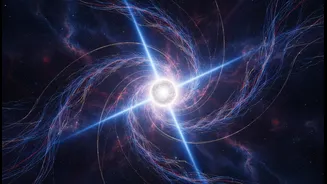
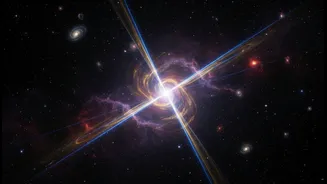
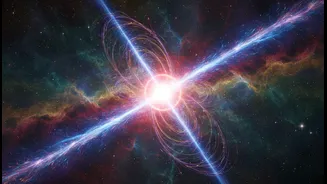
Imagine a star more massive than our sun collapsing under its own gravity into a sphere just the size of a city. What you’re picturing is a neutron star, one of the densest objects in the cosmos. Some of these neutron stars, known as pulsars, spin hundreds
of times per second, sweeping beams of radiation through space like a cosmic lighthouse. If Earth happens to be in the path of one of these beams, our telescopes see a regular pulse of light. For decades, these objects have fascinated astronomers, but understanding the complex environments that power them has been challenging. The headline-making discovery centers on a particular object called PSR J1101−6101, located within the aptly named 'Lighthouse Nebula.'
IXPE: NASA’s Magnetic Field Compass
To study these extreme objects, NASA, in collaboration with the Italian Space Agency, launched the Imaging X-ray Polarimetry Explorer (IXPE) in late 2021. IXPE isn't like other telescopes; its special power is measuring the polarization of X-rays. Think of light waves as vibrating in various directions. Polarized light is light that has been organized to vibrate in a single direction. This happens when light passes through or is created by intense magnetic fields. By measuring this polarization, IXPE can effectively act as a compass, mapping the structure and direction of magnetic fields in and around cosmic objects that are too small or distant to be seen in detail otherwise. This provides a new layer of information that was previously inaccessible to astronomers.
Mapping the Lighthouse Nebula
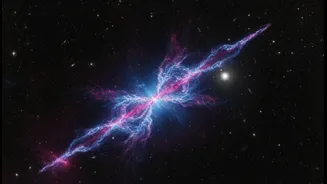
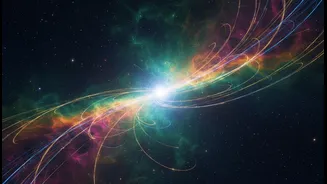
The latest results from IXPE give scientists their first direct map of the magnetic field around the Lighthouse pulsar's nebula. By analyzing the polarization of the X-rays streaming from it, researchers confirmed theories about how high-energy particles are accelerated and escape from the pulsar's immediate vicinity. The data revealed a fascinating and complex structure. The observations showed a dramatic difference in the magnetic field's orientation when measured in X-rays versus radio waves. This discrepancy points to a highly structured and complex environment, moving scientific understanding from theoretical models to direct evidence-based maps of how these powerful cosmic engines work.
Peering at an Even More 'Extreme' Pulsar
The headline also mentions an 'extreme pulsar,' a term that perfectly describes magnetars. These are a special class of neutron star with magnetic fields a thousand times stronger than a typical pulsar, making them the most powerful magnets known in the universe. Shortly after it began its mission, IXPE observed a magnetar named 4U 0142+61, located about 13,000 light-years away. The findings were stunning and challenged existing theories. Data suggested the magnetar has a solid, bare crust with no atmosphere—something scientists had theorized but never confirmed. Researchers were surprised to find that the gas on the star's surface may have reached a tipping point, turning solid due to the immense magnetic field, similar to how water turns to ice.
Why This New View Matters
These discoveries are more than just cosmic curiosities. They provide a real-world laboratory for testing physics under conditions that cannot be replicated on Earth. By mapping the magnetic fields of pulsars and magnetars, scientists can test fundamental theories of matter, gravity, and quantum electrodynamics in extreme environments. For the magnetar 4U 0142+61, IXPE observed that the polarization angle of its X-rays swung by exactly 90 degrees as the energy changed. This precisely matched theoretical predictions for what would happen to light emerging from a solid-crust star embedded in a powerful magnetosphere. This confirmation moves our understanding from sophisticated guesswork to observational fact.