


Our Atmosphere's Usual Rules
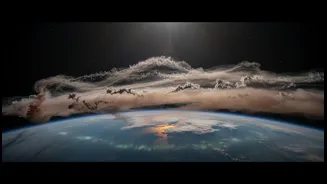
Think of the atmosphere as having two key layers. We live in the troposphere, where weather happens. It’s relatively warm and moist. Above it, starting around 10 kilometres up, lies the stratosphere. This layer is extremely dry, cold, and stable, acting
like a cap on the turbulent weather below. While small particles called aerosols—like dust, salt, and pollution—are common in the troposphere and help form cloud droplets, the stratosphere is typically clear. Very little water vapor or aerosol material is supposed to make it past the 'tropopause,' the boundary separating these two layers. This separation is crucial for maintaining the delicate chemical balance of the stratosphere, which hosts the vital ozone layer that protects us from harmful UV radiation.
A New Pathway to the Sky
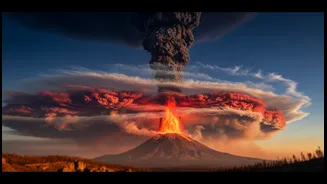
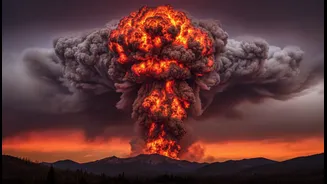
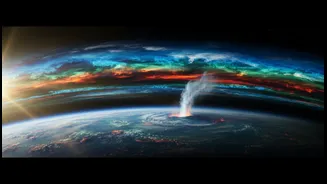
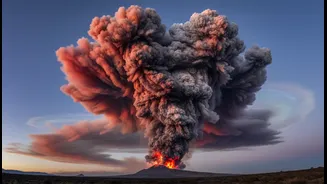
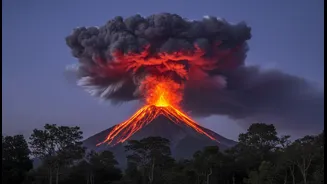
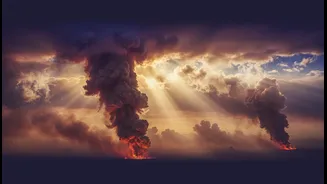
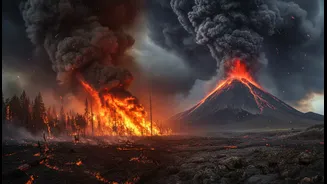
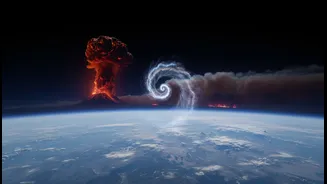
Scientists are discovering that this boundary isn't as impenetrable as once thought. Exceptionally intense events, particularly massive wildfires and some volcanic eruptions, are powerful enough to create their own weather systems. The intense heat from a megafire can generate a fire-driven thunderstorm, known as a pyrocumulonimbus (pyroCb) cloud. These are not ordinary storms; they act like atmospheric elevators, violently punching through the tropopause and injecting a cocktail of smoke, ash, and water vapor directly into the normally pristine stratosphere. Recent events, like the 2019-2020 Australian wildfires, have provided a stunning real-world laboratory, showing that these injections can be far larger and more impactful than previously imagined, with plumes reaching altitudes of over 30 kilometres.
Unexpected Chemistry Above
Once in the stratosphere, this mix of wildfire smoke and moisture starts to cause trouble. The stratosphere is so dry for a reason; its chemistry is finely tuned. The introduction of huge quantities of water vapor and aerosol surfaces creates new environments for chemical reactions. Scientists were stunned to find that smoke particles from the Australian fires persisted for more than a year, circling the globe. During that time, they provided new surfaces for molecules to interact in ways that deplete ozone. Studies have shown that these smoke aerosols can trigger reactions that widened the Antarctic ozone hole by as much as 10% in 2020 and caused a 3-5% ozone loss over mid-latitudes in the Southern Hemisphere.
How Smoke Particles Get Thirsty
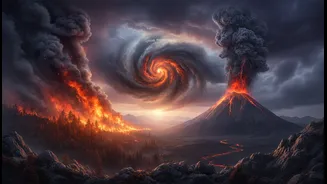
One of the most surprising discoveries is how wildfire aerosols behave. Normally, soot particles (black carbon) don't readily interact with water. However, research now shows that smoke from wildfires contains organic coatings that make the particles surprisingly effective at holding onto water vapor. This allows them to transport moisture into the stratosphere and also helps explain why they can form unique, long-lasting smoke-charged vortices. These swirling masses of smoke and air heat the stratosphere by absorbing sunlight, causing them to loft themselves even higher and spread out, prolonging their climate and chemical impact. This behavior is fundamentally different from that of volcanic aerosols, which are typically sulfate-based and reflect sunlight, leading to a cooling effect.
A Challenge for Climate Models
These new findings present a significant challenge for the models scientists use to predict future climate. Climate models are complex simulations of the Earth's systems, but they are only as good as the physics and chemistry programmed into them. Most current models do not fully account for the unique properties of wildfire smoke in the stratosphere or the sheer volume of water vapor that can be injected by events like pyroCbs or the 2022 Hunga Tonga volcanic eruption. Because these events can alter stratospheric temperature, moisture content, and ozone chemistry, leaving them out of models means our predictions could be missing a crucial piece of the puzzle. As climate change is projected to increase the frequency and intensity of large wildfires, this feedback loop could become increasingly important.