






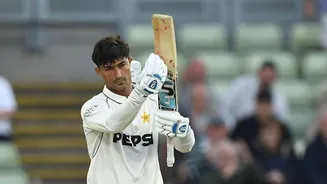
A Series of Near Misses
Across three Test matches in August and September 2026, England completed a convincing 3-0 series whitewash over a struggling Pakistan side. But beyond the result, the series was notable for what it lacked: a single individual century. This wasn't for a lack of
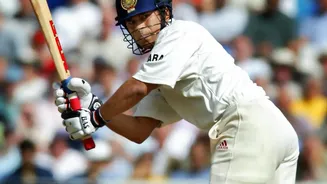
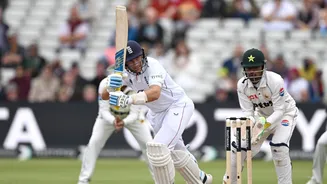
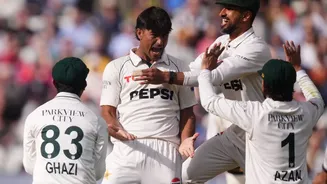
effort. Several batsmen on both sides came agonisingly close to the three-figure mark, only to fall short. For Pakistan, Saud Shakeel was dismissed for 97 at Lord's, while Shan Masood made 95 in Birmingham. England's Harry Brook was similarly frustrated, posting scores of 91 and 75. In a chase in the final Test, captain Joe Root and Jordan Cox both finished unbeaten with half-centuries, guiding their team to victory but remaining well shy of a ton. The most explosive innings of the series came from Pakistan's debutant Razaullah, who smashed an incredible 81 from just 63 balls, but even his whirlwind assault ended before the milestone could be reached. It was a consistent pattern of solid starts and substantial scores, but a collective inability to convert them into a landmark century.
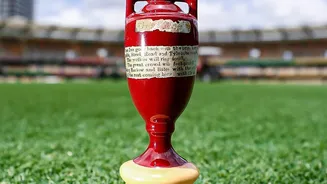
Rewinding the Clock to 1888
To find the last time a three-match Test series in England concluded without a single centurion, one has to travel back 138 years to the Ashes of 1888. That series was a world away from modern cricket. Played on uncovered pitches that gave bowlers extreme assistance, low scores were the norm. In the first Test at Lord's, Australia won by 61 runs despite being bowled out for 116 and 60. England fared even worse, managing just 53 and 62. The highest individual score in that entire match was a gritty 22 by Australia’s Percy McDonnell and Jack Blackham. The game was a brutal contest between bat and ball, with English bowlers like Bobby Peel and Australian duo Charlie Turner and John Ferris dominating proceedings on treacherous surfaces. The conditions were so challenging that merely surviving at the crease was a victory, let alone compiling a major innings. That era's cricket is almost unrecognisable compared to the game today.
Why the Century Drought is So Unusual
The century has become a definitive benchmark of batting excellence in Test cricket. In the modern game, they are a regular occurrence, thanks to a host of factors that have tilted the balance in favour of batters. Pitches are meticulously prepared and covered, removing much of the unpredictable bounce and movement that plagued 19th-century players. Bat technology has advanced significantly, with larger sweet spots allowing for more powerful shots and a greater margin for error. Furthermore, the overall professionalism, including fitness regimes and video analysis, allows batters to prepare more thoroughly than ever before. This is why a multi-Test series passing without a single hundred is so remarkable. It defies the statistical norms of the contemporary game, where top-order batters are often judged by their conversion rate of fifties into hundreds. The 2026 series was a throwback, a brief return to a time when the battle between bat and ball was a more even contest.
A Perfect Storm for Bowlers
So what caused this collective failure to reach three figures? It appears to be a combination of factors. While the pitches weren't as treacherous as in 1888, conditions throughout the series consistently favoured the bowlers. Former England captain Alastair Cook noted that the ball seemed to remain harder for longer, providing assistance to the seamers throughout the innings. England's bowling attack, led by player of the series Ollie Robinson, was relentless, while Pakistan's Mohammad Abbas also proved a constant threat, dismissing both England openers for ducks in the first over of the final run chase. Beyond the conditions, there may have been a mental block at play. As the series wore on and the century drought continued, the pressure on any batter who passed 50 would have mounted. Each near-miss likely added to the narrative, making the milestone feel ever more elusive. This created a perfect storm where good bowling, helpful conditions, and psychological pressure combined to keep every batter in the series short of that celebrated landmark.