




It’s a frustratingly common travel scenario: you’ve just stepped into the jet bridge and realise you left your headphones in the seat pocket. You turn to go back, but an airline agent politely but firmly stops you. Why the strict rule?
The Unbreakable Security Seal
The moment you step
off an aircraft, you are considered to have left a secure, sterile environment and re-entered the public space of the terminal. While you were just screened a couple of hours ago, in the eyes of aviation security, your status has changed. Allowing you to re-enter the plane without being re-screened would constitute a security breach. Airports are designed with a one-way flow for arriving passengers for this very reason. Once you cross that threshold from the jet bridge into the gate area, security protocols dictate that the 'seal' is broken. Letting even one person back would require compromising a system designed to prevent any unscreened individuals or items from getting onto an aircraft, a foundational principle of modern aviation security.
The Problem with the Passenger Count
Before any flight can push back from the gate, the airline must have a finalized, accurate passenger manifest and headcount. This isn't just for ticketing purposes; it's a critical component of flight safety. The final count is used to calculate the aircraft's weight and balance, which directly impacts its performance during takeoff and landing. The crew finalizes this count once boarding is complete and the doors are closed. If a passenger were to deplane and then re-board, it would create a discrepancy. The manifest submitted to authorities would be inaccurate, and the headcount would need to be officially revised. In the event of an emergency, first responders rely on this manifest to know exactly who was on board. An inaccurate count, even by one person, compromises the integrity of this vital safety and legal document.
Crossing International Lines
For international flights, the rules become even more stringent due to customs and immigration laws. When you disembark from an international flight, you are legally entering a new country. You are immediately directed toward immigration and customs checkpoints to be processed. Attempting to re-board the aircraft would be like trying to exit the country moments after entering, creating a bureaucratic tangle. Authorities require a precise record of who has entered their territory, and the flight manifest transmitted to border protection agencies serves as a key part of this record. Allowing a passenger to get back on the plane would mean they have to be officially processed as having departed the country, a procedure that simply isn't feasible at the gate. This ensures that every person's entry and exit is properly documented, a non-negotiable aspect of national sovereignty and security.
The Ripple Effect of Delays
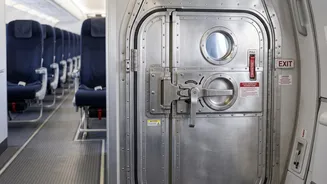
Beyond security and legalities, there's a powerful practical reason: operational efficiency. Air travel is a tightly choreographed dance of schedules and logistics. Once a flight has arrived, ground crews begin a series of time_sensitive tasks, from refueling to post_flight checks and preparing the cabin for its next journey. The time an aircraft spends at the gate is meticulously planned. Reopening a closed aircraft door isn't a simple matter; it can require the flight crew to run through certain pre_departure checks again, disarm and re_arm slides, and communicate with the control tower. Even a few minutes of delay to retrieve a forgotten item can have a cascading effect, potentially delaying the next flight using that aircraft, impacting crew duty time limits, and inconveniencing hundreds of other passengers. Airlines create policies that prioritize the on_time departure of the collective over the needs of an individual to keep the entire complex system moving.