

The Sun's One-Two Punch
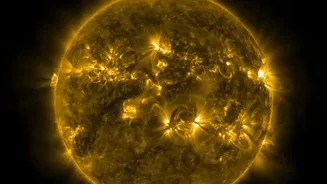
The headline mentions solar flares, and while they are immensely powerful, they aren’t the main threat to power grids. A solar flare is an intense burst of radiation—like a giant flash of light. Travelling at the speed of light, its effects, such as radio
blackouts, are felt on Earth in just over eight minutes, leaving no time for a warning. The real grid-killer is the Coronal Mass Ejection (CME), a slower but far more menacing phenomenon. Think of it this way: if a flare is the muzzle flash of a cannon, the CME is the cannonball. A CME is a colossal cloud of magnetized plasma and particles hurled from the sun. These CMEs can travel at millions of miles per hour, but that’s still slow enough to give us a one- to three-day warning before they slam into Earth's magnetic field. It's this impact that can induce powerful, damaging currents in our electrical infrastructure.
The Challenge of Staring at the Sun
So, if CMEs are the danger, how do we see them coming? It's harder than it sounds. The sun's main disk is so blindingly bright that it completely washes out its own atmosphere, the corona. The corona is millions of times fainter than the sun's surface. Trying to spot a faint cloud of gas erupting from the corona is like trying to see a firefly next to a searchlight. For centuries, the only time humans could glimpse the corona was during a total solar eclipse, when the moon perfectly blocks the sun's disk. But we can't wait for a rare eclipse to watch for dangerous solar weather. We need a way to create an artificial eclipse on demand.
An Artificial Eclipse in Space
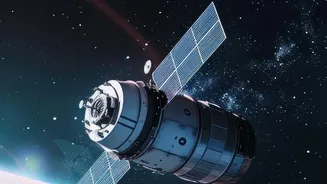
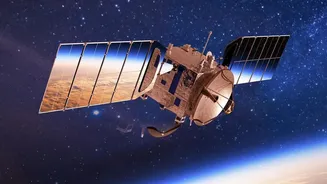
This is where the coronagraph comes in. Invented in the 1930s by Bernard Lyot, a coronagraph is a special telescope designed to do one thing: block the overwhelming light from a star's central disk to reveal the faint objects around it. Inside the telescope, a precisely machined object called an occulting disk physically blocks the direct light from the sun, just as the moon does during a natural eclipse. This allows the telescope's sensitive camera to capture images of the sun’s much dimmer outer atmosphere. Putting these instruments on satellites in space, like on the Solar and Heliospheric Observatory (SOHO), is far more effective than using them on the ground, as it avoids the light-scattering effects of Earth's atmosphere. This gives scientists a continuous, clear view of the sun's corona.
From Solar Eruption to Grid Alert
When a CME erupts from the sun, coronagraphs aboard satellites like SOHO and STEREO capture it. The satellites send a sequence of images back to Earth, showing a massive cloud of material expanding and moving away from the sun. Forecasters at agencies like NOAA's Space Weather Prediction Center analyze these images to determine the CME's size, speed, and direction. If a large CME is headed toward Earth, they issue a warning. This advance notice, ranging from 15 hours to several days, is critical. It gives power grid operators time to prepare. They can take protective measures like reducing load on certain transformers, postponing non-essential maintenance, and bringing extra generation capacity online to stabilize the grid against the coming geomagnetic storm. These actions can prevent catastrophic damage to high-voltage transformers, which are incredibly expensive and can take months or years to replace.
The Future of Solar Forecasting
Our ability to watch the sun is constantly improving. The workhorse SOHO satellite, launched in 1995, is being supplemented by newer and more advanced instruments. NOAA’s GOES-U satellite now carries a Compact Coronagraph (CCOR) that provides imagery much faster than older systems. More excitingly, NASA's PUNCH mission, a constellation of four small satellites launched in 2025, is revolutionizing the field. PUNCH creates a continuous, 3D view of the space between the sun and Earth, allowing scientists to track a CME for nearly its entire journey. In its first tests, PUNCH data has allowed forecasters to predict a CME's arrival time to within 30 minutes, a tenfold improvement on previous methods. This new level of precision will make our electric grid and other critical technologies even safer from the sun's wrath.