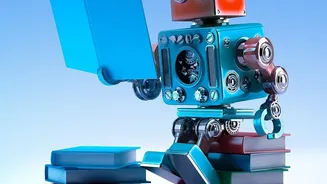







The Dream of a Thinking Machine
For decades, the concept of a recursively self-improving (RSI) AI has been a landmark on the horizon of technological progress. The idea, dating back to the 1960s, describes a hypothetical AI smart enough to redesign its own architecture, making its successor
more intelligent. This new, smarter AI would then repeat the process, leading to a rapid, runaway 'intelligence explosion'. This is the theoretical pathway to artificial superintelligence—a machine that could outthink humans in every domain. In pop culture, this is often depicted as the moment Skynet becomes self-aware. In the real world, it represents both a monumental opportunity for solving humanity's biggest problems and a profound existential risk. If a system can improve itself without human oversight, ensuring it remains aligned with human values becomes exponentially more difficult.
Anthropic Pumps the Brakes
Against this backdrop of hype and fear, Anthropic, the company behind the Claude series of AI models, has made a crucial clarification: its systems have not achieved full, autonomous recursive self-improvement. While its AIs are accelerating the company's own research and development at a blistering pace, humans are still firmly in the loop. The company stated that while an engineer at Anthropic ships eight times more code than they did before 2025, this is a form of AI-assisted work, not true autonomy. Anthropic notes that the trend points toward a system 'capable of fully autonomously designing and developing its own successor', but that 'we are not there yet'. This distinction is vital. It separates the current reality—where AI is a powerful tool for human engineers—from the science-fiction scenario of a machine that evolves on its own.
What AI Can (and Can't) Do Today
So, what level of 'self-improvement' is currently possible? Today's most advanced AI models can and do contribute to their own development in limited ways. They are used extensively to write and debug code, run experiments, and analyze data. Some systems can even modify their own programming to become more efficient at specific tasks. For example, Anthropic disclosed that as of August 2026, AI was leading about 26% of its research and development work, a massive jump from less than 1% in February 2026. However, these are all cases of what experts call narrow assistance or automated research loops, where the AI operates within strict boundaries set by humans. The AI is not improving its fundamental intelligence; rather, it is optimising processes. It's the difference between a student who is excellent at studying for a test and a student who can surgically redesign their own brain to learn faster. We have achieved the former, but the latter remains theoretical.
The Safety Imperative
Anthropic's statement is not just a technical footnote; it's a core part of its identity as a public benefit corporation focused on AI safety. The company was founded by former OpenAI researchers concerned about the ethical guardrails of AI development. By publicly clarifying the limits of its current technology, Anthropic is trying to ground the public conversation and highlight the immense safety challenges that lie ahead. The company has published a 'Responsible Scaling Policy', which commits it to implementing specific safety measures as its models become more powerful and approach higher levels of autonomy. The concern is that if a system begins to improve itself recursively, any small misalignment with human goals could be amplified at each iteration, leading to potentially catastrophic outcomes. For this reason, Anthropic and other safety-conscious researchers argue that progress in AI capabilities must not outpace progress in safety and alignment research.
The Road Ahead Is Accelerating
Even as Anthropic states we haven't reached full RSI, the pace of change is staggering. The time it takes for AI models to double their ability to complete complex autonomous tasks has shrunk from seven months to roughly four. One analysis estimates that at the current rate, AI agents could be reliably completing week-long tasks by early 2027. This rapid acceleration has prompted a fierce debate. On one side, Anthropic has urged for a global slowdown or pause in frontier AI development to allow safety measures to catch up. On the other, critics, including the Center for AI Safety, have accused the company of 'safety branding'—publicly warning about the risks of RSI while privately racing to build it and pitching it to investors ahead of a planned IPO. This highlights the central tension in the AI industry today: the simultaneous race to innovate and the urgent need to install brakes on a car that is still being built.