






China's Ambitious Lunar and Deep Space Goals
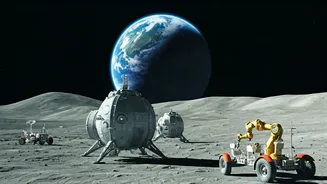
China's space program is set for an incredibly active year. The China National Space Administration (CNSA) is planning to launch the Chang'e-7 mission to the Moon's south pole, a region of intense international interest due to signs of water ice. [2,
10] This complex mission includes an orbiter, lander, rover, and a unique mini-flying probe to search for resources in shadowed craters. [14] Beyond the Moon, 2026 will see China's Tianwen-2 asteroid probe make a close approach to its target asteroid for observation and eventual sample return. [3, 7] The CNSA will also conduct multiple crewed missions to its Tiangong space station, including Shenzhou-23, and test reusable rockets, signaling a major push in both scientific exploration and operational capability. [3, 4, 7, 8]
Artemis III: A Critical Test in Earth Orbit
Originally slated as the mission to return humans to the lunar surface, NASA's Artemis III has been repurposed into a critical risk-reduction flight in low Earth orbit, now scheduled for 2027. [11, 25, 28] In February 2026, NASA announced the change, stating the mission will now serve as a crucial crewed shakedown of the rendezvous and docking capabilities between the Orion spacecraft and the new human landing systems being developed by SpaceX and Blue Origin. [11, 25] The four-person crew will test the docking procedures with pathfinder versions of the Starship and Blue Moon landers, ensuring the systems are safe before a landing is attempted on Artemis IV, now targeted for 2028. [11, 17, 25] This makes the mission a vital dress rehearsal for the return to the Moon rather than the landing itself.
The Rise of the Commercial Heavy-Lifters
The commercial space race is set to accelerate dramatically. SpaceX aims for an ambitious launch cadence for its fully reusable Starship, the most powerful rocket ever built. [22, 24] While a Mars launch in 2026 is considered a '50/50' chance by Elon Musk, the company must first demonstrate key milestones this year, including reliable payload deployment and landing procedures, to support NASA's future Artemis missions. [20, 26] Meanwhile, Blue Origin's heavy-lift reusable rocket, New Glenn, is also hitting its stride, with several missions planned for 2026 after its first flights in 2025. [13, 15, 30, 31] These commercial rockets are not just competitors; they form the backbone of a new space economy, from launching satellite constellations like Amazon's Project Kuiper to enabling deep-space exploration at a lower cost. [16]
Missions to Mars, Mercury, and Asteroids
While human missions capture headlines, 2026 is packed with significant robotic exploration. The Japan Aerospace Exploration Agency (JAXA) plans to launch its Martian Moons eXploration (MMX) mission in November 2026, which aims to land on Mars's moon Phobos and return a sample to Earth. [2] In the same month, the European Space Agency's (ESA) Hera mission will arrive at the asteroid Dimorphos to study the aftermath of NASA's DART impact, providing crucial data for planetary defense. [2] Also in late 2026, the joint ESA-JAXA BepiColombo mission is scheduled to enter orbit around Mercury after an eight-year journey, promising to unveil secrets of the solar system's innermost planet. [2, 14] However, NASA's ambitious Mars Sample Return mission has been effectively cancelled due to budget cuts, leaving a potential opening for China to be the first to return samples from the Red Planet in the early 2030s. [9, 12, 29]
New Commercial Capabilities in Orbit
The economy in low Earth orbit (LEO) continues to expand. In late 2026, Sierra Space's Dream Chaser is scheduled to make its first orbital flight. [6, 10] This uncrewed cargo spaceplane, which lands on a runway like an aircraft, promises a gentler and more flexible way to transport sensitive scientific cargo to and from space stations. [6, 12] Furthermore, the year could see the launch of the world's first commercial space station module, Haven-1, by Vast Space. [6] Planned for a launch no earlier than May 2026 aboard a Falcon 9, Haven-1 is designed to be a crucial step in maintaining a human presence in LEO as the International Space Station nears its retirement around 2030. [6]