




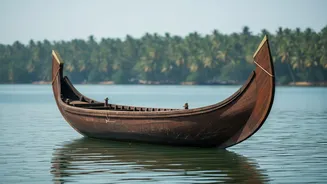
More Than Just a Boat
The Chundan Vallam, or snake boat, is a cultural icon of Kerala. Stretching over 100 feet, these magnificent wooden vessels were once battleships for local kings in the 14th century. Today, their battleground is the Vallam Kali, the series of boat races
held annually. Each boat belongs to a village, and it is revered almost as a deity, with traditions dictating that only men, barefoot, may touch it. Built from Anjili wood (wild jackfruit), which is known for its resistance to rot, the boats are designed for speed and agility, with a distinctive raised stern resembling a cobra's hood. The construction follows precepts from the ancient Sthapathya Veda, a treatise on building, making each boat a marvel of indigenous naval architecture.
A Closely Guarded Formula
The key to a snake boat's performance lies in a protective, friction-reducing coating applied to its hull. This isn't a modern varnish from a can; it's a traditional, organic mixture whose exact proportions are a fiercely guarded secret passed down through generations. The primary ingredients create a potent blend of waterproofing and slipperiness. The concoction typically includes fish oil, which penetrates and preserves the wood; the carbon-rich ash of burned coconut shells, which acts as a fine abrasive and filler; and eggs, which serve as a binding agent. This potent combination is designed to make the hull incredibly slick, reducing drag in the water, while also preventing water absorption that would make the boat heavier and slower. Sometimes, other resins or glues are added to fill gaps between the wooden planks, ensuring a perfectly sealed and smooth surface.
The Ritual of Preparation
Applying this mixture is a communal ritual that begins weeks before the race season. The entire process is a labour of love undertaken by the boat club members and villagers. First, the massive boat is hauled from the water and placed on supports. The hull is meticulously cleaned and inspected, with any necessary repairs made by the village carpenter. Then, the preparation of the special coating begins. The ingredients are mixed into a thick, dark paste. Teams of men then work together, applying the mixture by hand over every inch of the hull's exterior. They rub and polish the surface tirelessly, often while singing traditional boat songs, turning the arduous task into a celebration of community and shared purpose. Several layers may be applied, with each allowed to cure, creating a durable and glossy finish that gleams under the sun.
Where Tradition Meets Hydrodynamics
While the process is steeped in tradition, its effectiveness is rooted in sound scientific principles. The fish oil base provides a hydrophobic (water-repelling) layer, crucial for any wooden vessel. The fine carbon particles from the coconut shell ash perform a role similar to modern polishing compounds, smoothing out microscopic imperfections in the wood to create a slicker surface. This significantly reduces the frictional drag as the hull slices through the water. The egg acts as a natural emulsifier and binder, ensuring the oil and solid particles form a stable, uniform coating. Though not explicitly mentioned in the primary recipes for snake boats, shellac—a natural resin secreted by the lac bug—is a well-known traditional wood finisher in India, valued for its ability to seal wood and provide a tough, high-gloss finish. The entire process is a brilliant example of traditional wisdom achieving what modern marine engineers strive for with advanced polymers and antifouling paints: a fast, efficient, and protected hull.