






The 'Bow-and-Arrow' in the Sky
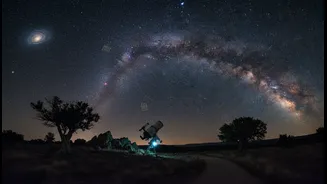
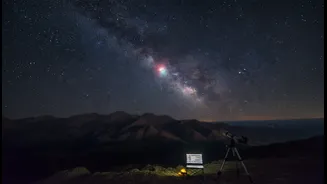
In a remarkable success for citizen-led research, a volunteer from a remote village in Sikkim played a key role in identifying a celestial object never clearly seen before. The citizen scientist, Pranim Limbo, was analysing data from a radio telescope
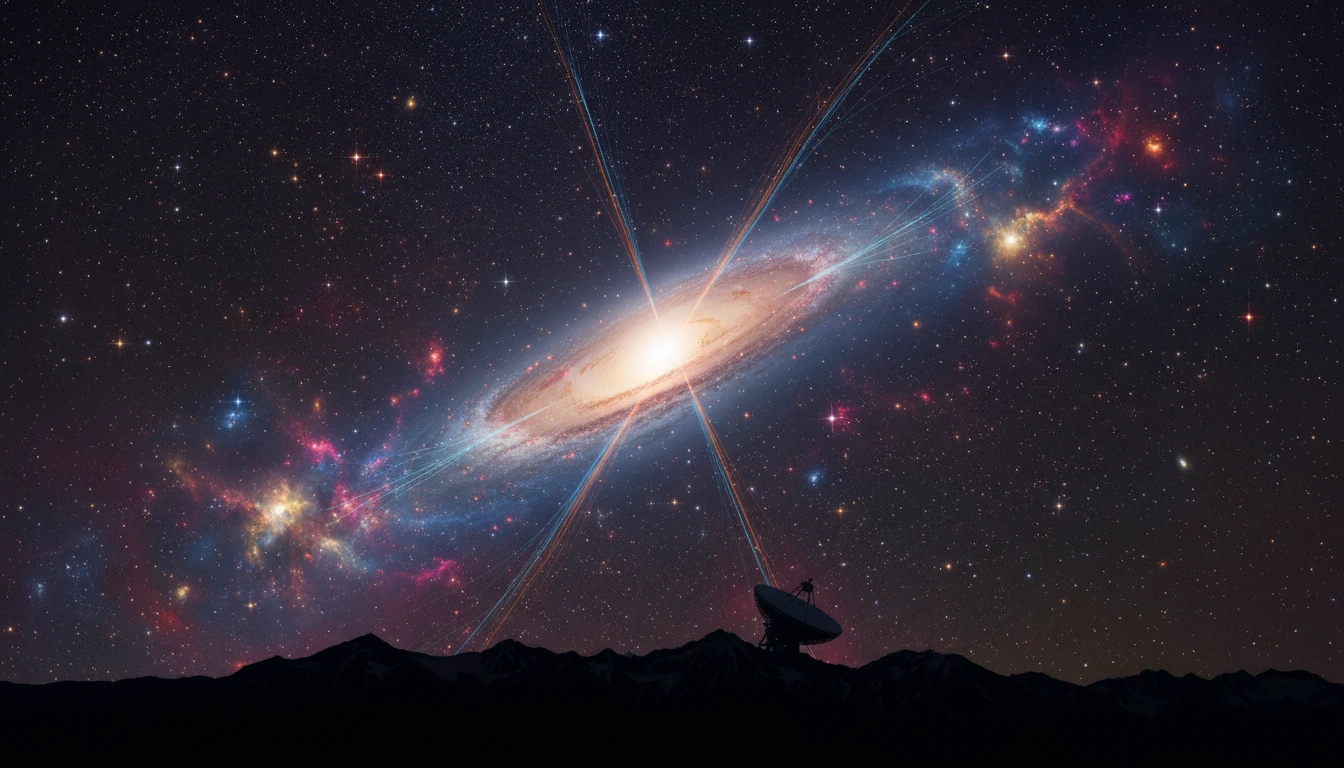
when he spotted the first clues of a highly unusual structure. This led a team of Indian astronomers to a stunning discovery: a massive radio galaxy shaped like a bow and arrow. Named RAD-BAARG (short for Bow-and-Arrow-shaped Radio Galaxy), the object spans a staggering 1.8 million light-years. The find was made public in the prestigious journal, Monthly Notices of the Royal Astronomical Society. What Limbo had flagged was a galaxy moving at supersonic speeds through a dense cluster of other galaxies, creating a giant shock wave nearly 20 times larger than our own Milky Way.
A New Kind of Discovery
This wasn't just any discovery; it was a testament to the power of the human eye. The galaxy’s strange shape is believed to be caused by it plunging through hot gas at immense speeds, between 1,000 and 3,500 kilometres per second. This motion bends its jets of radio-emitting plasma—one into a broad arc (the bow) and the other into a trailing, S-shaped tail (the arrow). While scientists had long theorised that such bow shocks could exist, a clear radio image had been elusive until now. Crucially, automated computer algorithms had previously scanned this exact region of space and classified the object as an ordinary galaxy, missing its unique shape entirely. It took a human volunteer, trained to spot unusual patterns, to notice something the machines had overlooked. The discovery was made using data from the Low Frequency Array (LOFAR) radio telescope.
The RAD@home Connection
Pranim Limbo made his contribution through the RAD@home Astronomy Collaboratory, India's first and only citizen science research platform in astronomy. Founded in 2013 by Mumbai-based astronomer Dr. Ananda Hota, RAD@home trains students, teachers, and any interested member of the public to analyse data from professional telescopes like the Giant Metrewave Radio Telescope (GMRT) near Pune. The platform operates on a simple but powerful premise: the sheer volume of data produced by modern telescopes is too vast for professional astronomers to analyse alone. RAD@home empowers volunteers across India to become 'e-astronomers' or 'i-astronomers', contributing to real scientific research from their homes. This model democratises science, allowing people from all walks of life, including those in remote regions like Sikkim, to participate in cutting-edge discoveries.
Why Sikkim Matters
The involvement of a citizen scientist from Sikkim is particularly significant. It showcases how such initiatives can extend scientific opportunities far beyond the traditional hubs of research and academia. By enabling individuals in geographically remote areas to engage with complex scientific data, these programs foster a culture of curiosity and build valuable skills. For a state like Sikkim, this creates new avenues for education and engagement, proving that a passion for science and a laptop are all you need to explore the universe. The success of participants like Limbo serves as a powerful inspiration, demonstrating that contributions to national and international scientific endeavours can come from anywhere. This type of distributed, collaborative research is not just a feel-good story; it's an increasingly vital part of how modern science gets done.
The Future is People-Powered
The discovery of the bow-and-arrow galaxy is not an isolated incident for RAD@home, which has been part of several other significant findings, including the identification of rare 'Odd Radio Circles' (ORCs). These successes highlight a global trend where citizen science is becoming indispensable. Projects from NASA and other international bodies rely on volunteers to classify galaxies, track asteroids, and even search for signs of extraterrestrial life. As telescopes become more powerful and generate even larger datasets, the role of citizen scientists will only grow. They provide a crucial layer of pattern recognition and curiosity that complements the processing power of artificial intelligence. By tapping into the collective intelligence of the public, science becomes a more inclusive, dynamic, and ultimately more powerful enterprise.