







An Ambitious Drone for an Alien Moon
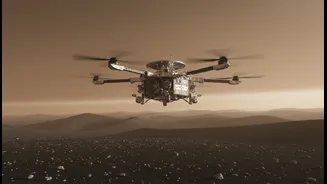
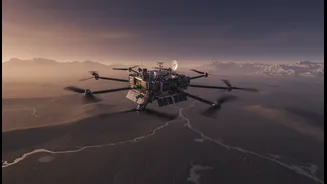
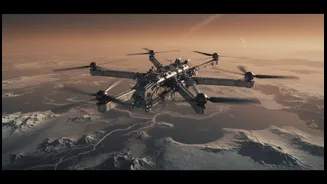
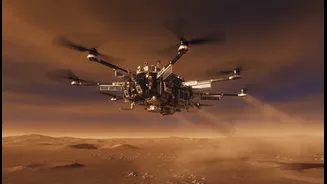
Scheduled to launch in 2028 and arrive at Saturn's largest moon in 2034, Dragonfly is a car-sized, nuclear-powered drone. Its destination, Titan, is a truly alien world. It has a thick atmosphere, clouds, and even rain — but its rivers and lakes are filled
with liquid methane and ethane, not water. More importantly for mission design, its surface temperature is a crushing -179 degrees Celsius. Previous missions to distant worlds have relied on stationary landers or slow-moving rovers, which can only explore a tiny patch of terrain. Dragonfly changes the game entirely. By using its eight rotors to fly, it can leapfrog across Titan's surface, covering more than 175 kilometres and visiting dozens of diverse locations, from icy dunes to the floor of an ancient impact crater. This unprecedented mobility is the first major shift it brings to mission design.
Engineering for the Deep Freeze
Surviving on Titan is no small feat. The extreme cold can render conventional electronics useless. Since Titan is so far from the Sun, and its atmosphere is so hazy, solar panels are not an option. Instead, Dragonfly is powered by a Multi-Mission Radioisotope Thermoelectric Generator (MMRTG), the same kind of nuclear battery used on the Mars Curiosity rover. This device converts heat from the natural decay of plutonium into electricity. However, its most clever design feature is how it deals with the cold. The mission's engineers have harnessed the waste heat from the MMRTG and circulated it through the lander's body to keep the scientific instruments and computers at their required operating temperatures. The entire craft is wrapped in thick layers of advanced insulation, creating a warm cocoon for its vital components. Ironically, engineers found that one of the biggest thermal challenges was preventing the drone from overheating when sitting still, as the MMRTG produces heat constantly.
Flying Blind and Flying Smart
The other monumental challenge is distance. Titan is over a billion kilometres from Earth, which means a radio signal can take up to 90 minutes to travel one way. This makes real-time control impossible; there's no joystick operator on Earth flying Dragonfly. The rotorcraft must be its own pilot, making it one of the most autonomous exploratory vehicles ever designed. The mission team will upload a series of goals, but Dragonfly will execute the flights on its own. Using its cameras and sensors, it will scan the terrain below to identify safe landing zones, navigate hazards, and decide where to collect samples. This level of autonomy is crucial for long-duration missions far from home. Dragonfly will spend most of its time on the ground, taking a full Titan day (about 16 Earth days) to recharge its batteries from the MMRTG before making its next flight. This patient, methodical, and self-reliant approach is a masterclass in how to conduct complex science when you can't be there to supervise.
A New Playbook for Exploration
Dragonfly represents a new paradigm. It combines nuclear power for survival in cold, dark environments with advanced autonomy to overcome the tyranny of distance. This combination unlocks a whole new class of celestial bodies for in-depth exploration. Previously, worlds like Titan were accessible only to fly-by missions or single-site landers. With the blueprint provided by Dragonfly, future missions could use similar flying platforms to explore other worlds with atmospheres, from the clouds of Venus to other icy moons in the outer solar system. It proves that we can move beyond just landing on a world and begin to truly explore it, hopping from one point of scientific interest to the next. The lessons learned from designing and operating Dragonfly will directly inform how NASA builds its next generation of explorers, creating smarter, more resilient, and more mobile craft capable of answering fundamental questions about the cosmos.