




A Familiar Galaxy Full of Surprises
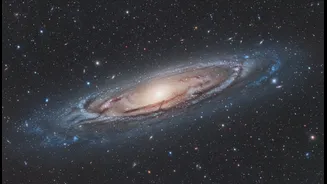
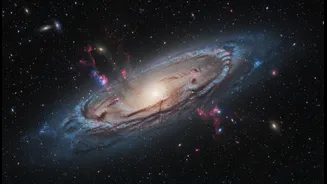
At about 11 million light-years away, Centaurus A is practically next door in cosmic terms. It's one of the brightest and largest radio galaxies in our night sky, making it a favourite target for astronomers. But it’s also famously unusual. Unlike the neat
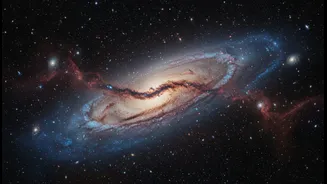
spirals of many galaxies, Centaurus A is a chaotic mix, the result of a violent collision with another galaxy roughly two billion years ago. This cosmic smash-up left behind a warped disc of gas and a prominent, dark lane of dust that slashes across its bright centre, hiding many of its secrets from view. While telescopes like Hubble could see its shape, this thick dust blocked a clear view of the galaxy’s core.
Webb's Infrared Eyes Pierce the Veil
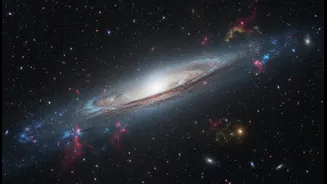
This is where the James Webb Space Telescope (JWST) changes the game. Webb observes the universe primarily in infrared light, which can pass through the thick cosmic dust that blocks visible light. To mark its fourth anniversary, NASA aimed Webb’s powerful Mid-Infrared Instrument (MIRI) and Near-Infrared Camera (NIRCam) at Centaurus A. The resulting images are the most detailed ever taken of the galaxy. What once looked like a hazy glow is now resolved into a stunning tapestry of millions of individual stars. For the first time, scientists can see the galaxy's core star by star, uncovering intricate filaments and glowing clouds of warm dust that were previously hidden.
A Tale of Creation and Destruction
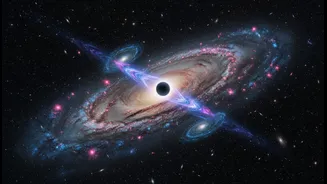
At the heart of Centaurus A lies a supermassive black hole with the mass of 55 million suns. This monstrous engine is actively feeding on the gas and dust around it, launching powerful jets of energy that ripple through the galaxy. These new Webb observations provide a rare, close-up view of the complex relationship between a black hole and its host galaxy. The data reveals that the black hole’s influence is a double-edged sword. On one hand, its energetic output can compress surrounding gas, triggering frantic bursts of new star formation. On the other, it can also blow essential star-forming material away, effectively choking off future growth. Studying this cosmic interplay in Centaurus A helps astronomers understand how all galaxies, including our own, evolve over billions of years.
Reading the Scars of a Cosmic Collision
The new images also shed light on Centaurus A’s violent past. The spectacular parallelogram-shaped dust structure and a mysterious, delicate S-shaped feature near the core are scars left behind by its ancient galactic merger. By resolving individual stars, astronomers can now distinguish between different generations. This allows them to create a more precise timeline of the galaxy’s history, pinpointing when the collision sparked new waves of star birth and how the galaxy has been shaped by the ongoing activity of its central black hole. It transforms Centaurus A from a static picture into a dynamic record of cosmic history, written in its stars and dust.