



A Steamy Discovery in a Stellar Nursery
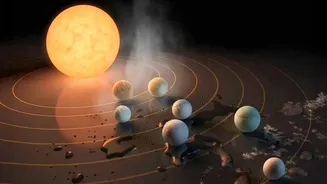
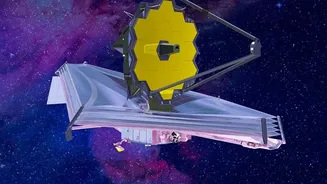
The James Webb Space Telescope has detected significant water vapour in the inner region of a planet-forming disc around a young star known as PDS 70, located 370 light-years from Earth. This isn't just any star system; it's a known stellar nursery where
at least two gas-giant planets are already forming. The water was found in the inner disk, a zone where rocky, Earth-like planets are expected to assemble. This marks the first time water has been spotted so close to a star within a disc that is actively building planets, a measurement that was impossible before the unparalleled sensitivity of the JWST. The discovery was surprising to scientists because it was thought that the harsh radiation from a star would destroy any water so close to it, leaving a dry environment for planet formation.
How Webb Sees the Invisible
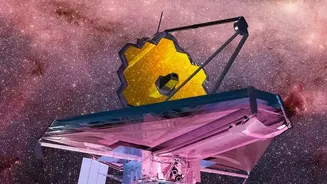
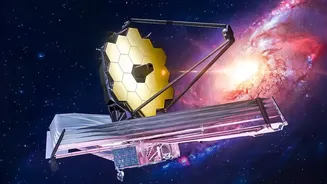
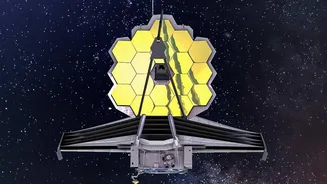
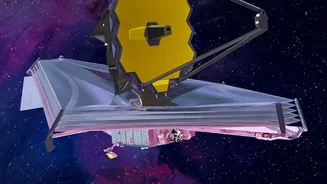
So, how does a telescope 1.5 million kilometres away spot water in a system trillions of kilometres further? The answer lies in the JWST's powerful Mid-InfraRed Instrument, or MIRI. This highly advanced tool is essentially a heat-sensing camera and spectrograph. When starlight passes through the gas and dust of a protoplanetary disk, molecules like water absorb specific wavelengths of light. This leaves a unique chemical 'fingerprint' in the light's spectrum. MIRI is exquisitely tuned to pick up these subtle signatures in the infrared spectrum, a range of light invisible to the human eye. Because JWST operates in space, it avoids the interference of water vapour in Earth's own atmosphere, which has long hampered such observations from the ground. This technological leap allows astronomers to not just detect but also map the distribution of key molecules for the first time.
The Ingredients for a Water World
Finding water is one thing, but finding it in the 'terrestrial zone' of a protoplanetary disk is a game-changer. This is the region where planets like Earth, Mars, and Venus formed in our own solar system. The PDS 70 system's inner disk also contains silicates, the raw material for building rocky worlds. The presence of both water vapour and silicates implies that any rocky planets forming there will have access to water from the very beginning. For decades, scientists have debated how Earth got its water, with one leading theory being that it was delivered later by icy comets and asteroids. This discovery suggests another possibility: that planets can be born 'wet,' incorporating water directly from the primordial disk. It provides a crucial link between water in the cosmos and the potential for water-rich planets.
Why This Finding Matters
This detection moves the needle significantly in our understanding of planetary habitability. Water is essential for life as we know it, and its availability is a primary factor when scientists assess an exoplanet's potential to host life. By confirming that water can survive and persist in the very regions where rocky planets are born, the JWST has strengthened the case that the building blocks for life are not rare. Before this, astronomers worried that these crucial inner disks might be too dry. The discovery at PDS 70 shows that a wet environment for planet formation can exist, potentially making the galaxy a much more promising place to find other habitable worlds. As one scientist noted, the finding is 'extremely exciting' because it directly probes the conditions under which planets similar to Earth are formed.
What Happens Next in the Search?
The discovery at PDS 70 is not an endpoint but a thrilling new starting line. Researchers will now use the JWST to survey other planet-forming disks to see if water is a common ingredient in their terrestrial zones. They will also seek to understand the origin of the water in the PDS 70 system. Is it forming in place, or is it being transported inward from colder, icier regions of the disk? Answering this will help refine models of planet formation everywhere. Furthermore, while astronomers have yet to detect any planets forming within PDS 70's inner disk, the presence of these raw materials makes it a prime target for future observation campaigns. Each new detection of water, whether in the atmosphere of a mature planet or the dust of a stellar nursery, brings us one step closer to answering humanity's most profound question: are we alone?