




The gleam of gold in an investment portfolio often feels like a guarantee of stability. So, when prices take a sudden dive, it’s natural to feel a sense of panic. But what if those alarming drops are not just normal, but expected?
Understanding the 'Drawdown'
First, let's de-jargonize
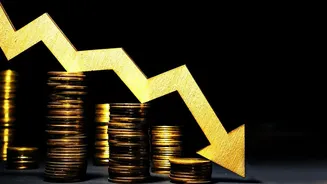
a key term: 'drawdown'. In finance, a drawdown is simply the measure of a decline from a peak to a subsequent low. If gold hits a record high and then falls 10%, it has experienced a 10% drawdown. These are not just theoretical; they are a recurring feature of the gold market. Historical data shows that for a significant portion of its trading history, gold has been in a state of drawdown, trading below a previous peak. In fact, one study found that between 1996 and 2026, gold's price was more than 10% below its record high over 61% of the time.
How Common Are These Dips?
Price corrections are not a rare catastrophe; they are a regular part of gold's long-term journey. Data on gold bull markets reveals that corrections are not a flaw but a feature. The major bull market of the 1970s, for example, witnessed five corrections of over 15%. More recently, the bull cycle from 2001 to 2011 also had several pullbacks in the 15-20% range. Looking at the data since 1996, there have been at least eight distinct drawdowns of 10% or more, with some being much deeper. These episodes can be triggered by a variety of factors and are a normal part of market cycles for the precious metal.
What Drives the Volatility?
Gold's price doesn't exist in a vacuum. It is influenced by a complex interplay of global economic forces. Key drivers include the monetary policy of central banks, especially the U.S. Federal Reserve. When interest rates rise, holding a non-interest-bearing asset like gold becomes less attractive, which can push prices down. The strength of the U.S. dollar is another critical factor; a stronger dollar typically exerts downward pressure on gold prices. Furthermore, general market sentiment plays a huge role. In times of economic stability or a 'risk-on' mood, investors may sell safe-haven assets like gold to pursue higher returns elsewhere, triggering a correction.
The Bigger Picture: Recovery and Long-Term Performance
While the dips can be sharp, the story doesn't end there. History shows that gold has a resilient track record of recovery, although patience is often required. The time it takes to regain a previous high can vary significantly, from several months to several years, depending on the depth of the fall and the broader economic climate. For example, a nearly 30% drop in 2008 took around 18 months to fully recover from its prior peak. A much deeper, 45% drawdown that started in 2011 took almost nine years to overcome. Despite these periods of decline, gold has proven to be one of the top-performing assets over long-term windows, often acting as a crucial hedge during major market shocks and geopolitical crises.
What This Means for Indian Investors
For Indian households, where gold is a cornerstone of savings and culture, this long-term perspective is vital. The price of gold in India is affected by global trends but also by local factors, like the exchange rate between the rupee and the U.S. dollar and seasonal demand during festivals and weddings. A falling global price can be amplified or softened by currency movements. Understanding that drawdowns are normal can help an investor avoid the common mistake of panic-selling at a low. Instead, these periods can be viewed as part of the natural rhythm of a long-term investment. The historical pattern suggests that for those who are not looking for short-term gains, these corrections do not invalidate gold's role as a store of value and portfolio diversifier.