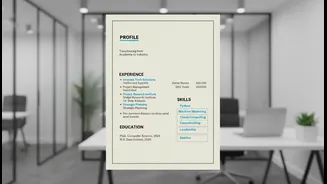









From Research to Results: Translating Your Skills
The first step in adapting your CV is to translate your academic experience into business-centric skills. Industry recruiters may not grasp the direct value of "publishing peer-reviewed papers" or "conducting ethnographic research." Your task is to rephrase
these accomplishments to highlight their practical application in a corporate setting. Instead of listing academic duties, focus on the transferable skills you developed. For example, extensive grant writing demonstrates persuasive communication and financial planning. Managing a research lab can be framed as project management, including budgeting and team leadership. Think about the core competencies behind your academic work: critical thinking, data analysis, problem-solving, and collaboration are all highly sought-after in industry. Avoid academic jargon. Instead of saying you “developed a novel algorithm for data clustering,” you could write, “designed and implemented a new data analysis technique that improved processing efficiency by 20%.” This reframing makes your expertise immediately understandable and relevant to business objectives.
The Power of Numbers: Quantifying Your Impact
Once you've translated your skills, the next crucial step is to quantify your achievements. Numbers provide concrete evidence of your impact and help your resume stand out to recruiters who scan dozens of applications. Instead of simply describing your responsibilities, use metrics to showcase the scale and success of your work. For instance, don’t just say you “mentored junior researchers.” Instead, state that you “mentored and trained 5 junior researchers, leading to two co-authored publications and a 15% improvement in project completion times.” If you managed a lab budget, specify the amount. If your research led to efficiencies, calculate the time or cost savings as a percentage. Even achievements that seem qualitative can often be quantified. For example, instead of mentioning you “presented at conferences,” specify that you “presented research findings to audiences of over 200 at three international conferences, receiving positive feedback on communication clarity.” This approach transforms vague duties into compelling, evidence-backed accomplishments that demonstrate your ability to deliver measurable results.
Mirror the Mission: Aligning With The Role
Finally, your resume should not be a one-size-fits-all document. For each industry role you apply for, you must align your CV with the specific job description. Many companies use Applicant Tracking Systems (ATS) to screen resumes for keywords, so incorporating language from the job posting is essential to passing this initial filter. Carefully analyze the job description to identify the key skills and qualifications the employer is seeking. Then, tailor your professional summary, skills section, and work experience to reflect that language. If a job ad emphasizes “cross-functional team collaboration,” make sure your resume provides a specific example of when you worked with different departments or research groups. If it lists “data-driven decision making,” your bullet points should highlight how you used data to arrive at conclusions or influence project direction. This targeted approach shows the recruiter that you have not only read the job description but also possess the exact qualifications they need, making you a much stronger candidate.