








The Old Race: When Bigger Was Better
For the last few years, the artificial intelligence race was straightforward: who could build the biggest, most powerful model? The journey from GPT-3 to GPT-4 was defined by scaling up, with companies pouring billions into creating massive general-purpose
models. The prevailing wisdom was that more data and more parameters would inevitably lead to more intelligence, and for a time, that was largely true. Each new flagship model from OpenAI, Google, and Anthropic set new performance benchmarks, leaving competitors scrambling to catch up. This era conditioned us to see the AI race as a heavyweight title fight, with the biggest model claiming the belt. That assumption is now cracking under the weight of real-world demands.
The New Battleground: A Mix of Specialists and Speedsters
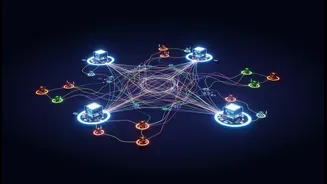
The focus in 2026 is shifting from a single, monolithic model to a diverse portfolio of AI systems. Companies are realizing that a one-size-fits-all approach is both inefficient and expensive. The new strategy involves creating smaller, purpose-built models trained on industry-specific data for specialized tasks. For example, a model for legal contract analysis or medical diagnostics can outperform a general model. We're also seeing a rise in 'agentic' AI, systems that can perform complex, multi-step tasks with minimal human input. Google's Gemini 3.5, for instance, is designed to execute these workflows, acting more like a proactive assistant than a simple question-and-answer tool. This shift means the race is no longer just about raw intelligence, but about having the right tool for the right job.
Efficiency and Cost Are Now King
As AI moves from a novelty to a core business utility, the economics of running these models at scale has become a primary concern. The brute-force approach of the past is giving way to a focus on 'intelligence per watt'. Architectural innovations like 'mixture-of-experts' (MoE), used in models like Meta's Llama 4, allow for massive model capacity without a proportional increase in computing costs. This makes powerful AI more accessible. Similarly, Microsoft is reportedly deploying its own smaller, in-house MAI models for routine tasks in Office apps to reduce reliance on more expensive frontier models. For many real-world use cases, the performance gap between the top models from OpenAI, Anthropic, and Google has narrowed, making cost and speed the new differentiators.
The Great Divide: Open Source vs. Closed Gardens
A major strategic fault line in the AI race is the split between open-source and proprietary models. Meta has aggressively pushed its Llama family as powerful open-source alternatives, allowing developers to download, modify, and own their AI stack. This approach has dramatically closed the capability gap with closed models, with some benchmarks showing near-parity for many tasks. On the other side, companies like OpenAI and Anthropic keep their most advanced models, such as the recently announced GPT-5.6 family and Claude Fable 5, as proprietary systems accessible via APIs. This creates a classic strategic choice for businesses: the control and customization of open source versus the cutting-edge performance and managed infrastructure of closed systems. This competition is no longer just about technical benchmarks, but about fundamentally different business models.
So, What Is GPT-5.6?
The headline's mention of 'GPT-5.6' points to a real and recent development. In early July 2026, reports surfaced around OpenAI's launch of a new model family—GPT-5.6, with variants named Sol, Terra, and Luna—behind a government-managed access list. This represents the next step in frontier model development, following a rapid succession of releases in the GPT-5 family throughout late 2025 and 2026. However, the key takeaway isn't just that a more powerful model exists. It's that even this new frontier model is entering a marketplace that is fundamentally different from the one its predecessors dominated. The conversation is no longer just about its raw power, but how it competes in a landscape where cost, efficiency, and openness are equally important metrics for success.