




The Allure of an Alien Ocean
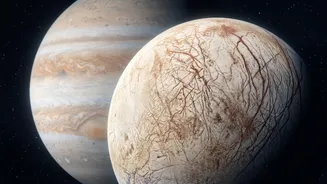
For decades, scientists have been captivated by Jupiter's moon Europa. It is one of the smoothest objects in the solar system, suggesting its surface is constantly being renewed. The most compelling theory is that tidal forces from Jupiter's immense gravity
flex and warm Europa's interior, maintaining a global ocean of liquid saltwater beneath its frozen crust. Evidence from NASA's Galileo mission in the 1990s detected a magnetic field that strongly suggests the presence of a conductive fluid, like a salty ocean. Scientists estimate this ocean could contain more than twice the amount of water as all of Earth's oceans combined, making it a prime target in the search for life beyond our planet.
Meet the Galactic Explorer
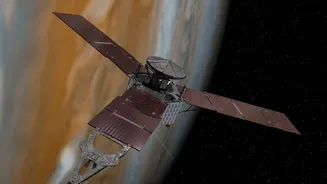
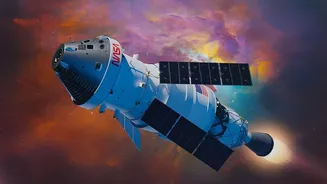
Enter the Europa Clipper, NASA's largest spacecraft ever built for an interplanetary mission. Launched in October 2024, the Clipper is currently on a multi-year, 2.9-billion-kilometer journey to the Jovian system. As of September 2026, the spacecraft has already completed a gravity-assist flyby of Mars in 2025 and is preparing for a crucial flyby of Earth in December 2026. This maneuver will use our planet's gravity to slingshot the probe toward Jupiter, where it is scheduled to arrive in April 2030. Spanning the length of a basketball court with its solar arrays deployed, the craft is a testament to modern engineering, designed to withstand the harsh radiation environment around Jupiter.
A Toolkit for Discovery
The Clipper is outfitted with a suite of nine advanced scientific instruments designed to work in concert. Its ice-penetrating radar, called REASON, will probe the icy shell to confirm the ocean's existence and measure the ice's thickness. Spectrometers like MISE will map the surface composition, looking for salts and organic molecules that might hint at the ocean's chemistry. A powerful magnetometer will measure the strength and direction of the magnetic field to characterize the ocean's depth and salinity, while high-resolution cameras will capture stunning images of the fractured surface, looking for signs of recent geological activity or even plumes of water vapor erupting into space.
The Hunt for Habitability
It is important to note that the Europa Clipper is not a life-detection mission. Instead, its primary goal is to determine if Europa possesses the three key ingredients for life as we know it: liquid water, essential chemical elements, and an energy source. We know the water is likely there. The mission will investigate the chemistry of the surface and any potential plumes for elements like carbon, hydrogen, nitrogen, and oxygen. The energy could come from tidal heating and chemical reactions at the seafloor, possibly creating hydrothermal vents similar to those found on Earth's ocean floors, which support entire ecosystems without sunlight. By assessing these factors, Clipper will determine if Europa is a habitable world.
A Dance of Complex Orbits
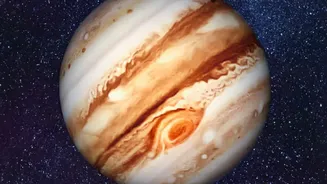
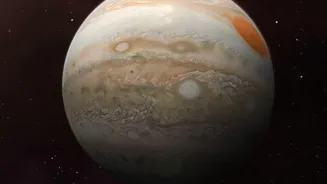
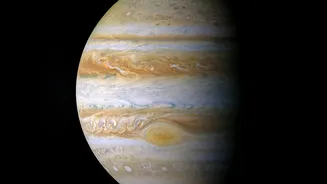
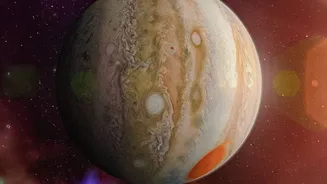
Upon reaching the gas giant in 2030, the spacecraft won't orbit Europa directly. The radiation trapped by Jupiter's magnetic field is so intense that it would quickly damage the probe's electronics. Instead, Clipper will enter a long, looping orbit around Jupiter itself. From there, it will perform nearly 50 close, rapid flybys of Europa, dipping into the high-radiation zone just long enough to gather data before retreating to safety. These flybys will range from altitudes of 2,700 kilometers down to a breathtaking 25 kilometers, allowing scientists to map and study a wide variety of terrains across the moon's mysterious surface.