


The Red Planet’s Poisonous Ground
For decades, scientists have envisioned future astronauts on Mars living off the land, a practice known as in-situ resource utilization (ISRU). A key part of this vision involves using Martian soil, or regolith, to grow crops. There’s just one major problem:
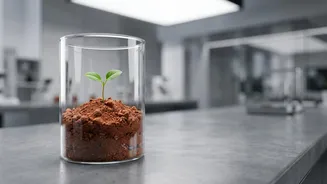
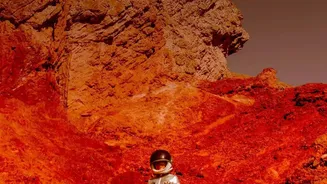
the ground is poisonous. When NASA’s Phoenix lander tested the soil in 2008, it made a startling discovery: the regolith is laced with perchlorates. These salts, composed of chlorine and oxygen, are toxic to humans and most plant life. At concentrations of 0.5% to 1.0% by weight, the Martian surface is far too contaminated for conventional agriculture. Any astronaut who ingested contaminated food or even inhaled too much dust could suffer from serious thyroid problems. This single discovery transformed the challenge of Martian farming from a difficult engineering problem into a complex chemical and biological one. Before we can plant the first seed on Mars, we have to figure out how to clean the soil.
A Fresh Look From a New Generation
Solving the perchlorate problem has occupied scientists at major space agencies and universities, with proposed solutions ranging from washing the soil with immense amounts of precious water to deploying specialized bacteria to break down the toxins. But a fresh and elegant concept recently emerged from a more unexpected source: three high school students from Texas. Varshini Gandreddy, Dhiti Koyya, and Raaga Bukkaraju developed a project called 'Gaia's Outpost' for the Conrad Challenge, a prestigious innovation competition. Their goal was to tackle the food production problem head-on. Instead of focusing on a single, complex chemical reaction, they designed an integrated system that would take the raw, toxic Martian regolith and process it into a medium capable of supporting plant life inside a habitat. Their work earned them the Simon Glinsky Expo Exhibit Award at the 2026 Conrad Challenge Innovation Summit, held at Space Centre Houston, placing their idea firmly on the radar of the aerospace community.
From Toxic Soil to Sustainable Farming
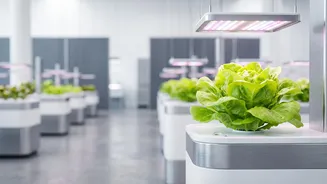
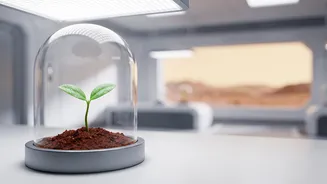
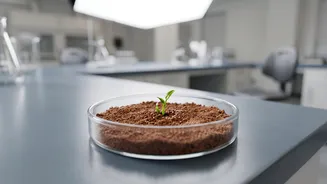
The core of the Gaia's Outpost concept is its practicality. Long-duration missions to Mars are severely limited by payload mass; every kilogram of food, water, and equipment must be launched from Earth at tremendous cost. The students’ proposal addresses this by creating a self-sustaining agricultural system using resources already on Mars. Their system is designed to detoxify the regolith and prepare it for cultivation, allowing astronauts to grow fresh food locally. By turning a planetary liability—the abundant but toxic soil—into a valuable asset, the project offers a path to greater mission independence. While the specific methods are part of their proprietary proposal, the strength of the idea lies in its systems-level thinking. It's not just a lab experiment; it’s a blueprint for a functional piece of a future Martian base, designed to integrate directly into a habitat and reduce the immense logistical burden of resupplying a crew from nearly 100 million miles away.
More Than Just a Meal
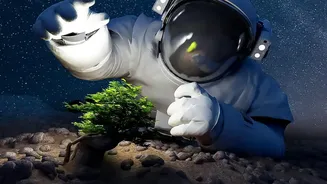
The students behind Gaia's Outpost envision their system as more than just a Martian vegetable patch. In their proposal, the vegetation would also contribute to the habitat's life support system by producing oxygen. This complements other ISRU efforts, like NASA's MOXIE experiment, which has already successfully generated oxygen from Mars's carbon-dioxide atmosphere. Furthermore, they argue that the presence of living plants would provide a crucial psychological boost for astronauts. On a barren, isolated world, a small patch of green could offer a vital connection to Earth, reducing stress and improving mental well-being during missions that could last for years. The project was presented not just as a scientific concept but as a potential commercial product, with the team estimating costs and targeting space agencies and private companies as future customers.