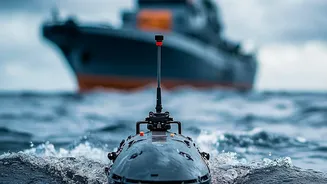


As the global shipping industry sails towards a future of self-driving vessels, a key challenge emerges: how to test this new technology safely? Researchers at IIT Madras have an answer with an innovative new platform called SeaNav.
The Global Push for Autonomous Ships
The world's oceans
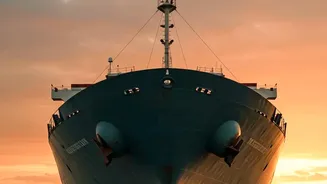
are the highways of global trade, with over 80% of goods transported by sea. For decades, this has depended entirely on human crews. Now, the maritime industry is on the brink of a revolution, much like the automotive world: the rise of autonomous ships. These Maritime Autonomous Surface Ships (MASS) promise to make shipping more efficient, reduce operational costs, and, most importantly, minimise human error, which is a factor in a significant number of marine incidents. From container ships to tankers, the goal is to develop vessels that can navigate complex waters, dock, and manage their journeys with minimal to no human intervention. However, getting there is not as simple as just launching a ship and letting it go.
The High-Stakes Challenge of Real-World Testing
Developing the artificial intelligence that guides these vessels is only half the battle. Testing the algorithms is a massive hurdle. Real-world trials are incredibly expensive, logistically complex, and carry significant risks. An unproven navigation algorithm could lead to catastrophic collisions with other vessels, damage to port infrastructure, or environmental disasters like oil spills. Safely evaluating how an autonomous system would react to a sudden storm, dense fog, or a crowded shipping lane is nearly impossible to do live without endangering people and property. This bottleneck has been a major barrier to the widespread adoption of autonomous maritime technology, creating a critical need for a new way to test and validate these systems.
Introducing SeaNav: A Digital Twin for the Seas
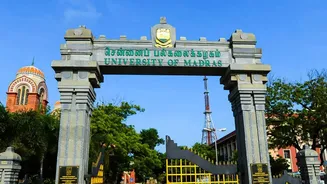
This is precisely the problem that researchers at the Indian Institute of Technology Madras's Department of Ocean Engineering set out to solve. Their solution is 'SeaNav', a sophisticated simulation platform that acts as a 'digital twin' for the maritime world. SeaNav creates a high-fidelity, realistic virtual environment where autonomous navigation systems can be put through their paces. Built on the Unity3D game engine, it can accurately replicate everything from ocean waves and currents to the specific movements of different types of ships and complex port environments. This allows developers to test their algorithms in thousands of scenarios without ever putting a real ship in the water.
How the Virtual Ocean Works
Led by Associate Professor Dr. Suresh Rajendran, the team has designed SeaNav to be a comprehensive testing ground. The platform can simulate various ships, sensors, weather conditions, and vessel traffic in real-time. To ensure its accuracy, the simulator was calibrated using a benchmark model of a 320-meter-long commercial tanker, making its virtual results closely reflect real-world performance. By combining digital twin technology, AI, advanced sensor fusion, and even virtual reality, SeaNav provides an environment where both autonomous systems and human operators can be trained efficiently and safely before they are deployed in the real world.
Bolstering India’s Maritime Vision
The development of SeaNav is more than just an academic achievement; it aligns directly with the Government of India's strategic goals. Initiatives like the 'Sagarmala Programme' and the 'Maritime India Vision 2030' heavily emphasize the adoption of digital technologies and the development of smart ports. SeaNav provides a crucial tool to accelerate this vision. According to the development team, the platform can be used to enhance safety at major Indian ports such as Chennai, Mumbai, Visakhapatnam, and Kochi by helping to develop AI-assisted navigation systems that reduce the risk of collisions and grounding. Furthermore, its multi-vessel simulation capabilities make it valuable for applications beyond commercial shipping, including coastal surveillance, search-and rescue operations, and maritime defence.