
The Challenge of Stargazing
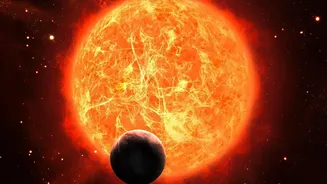
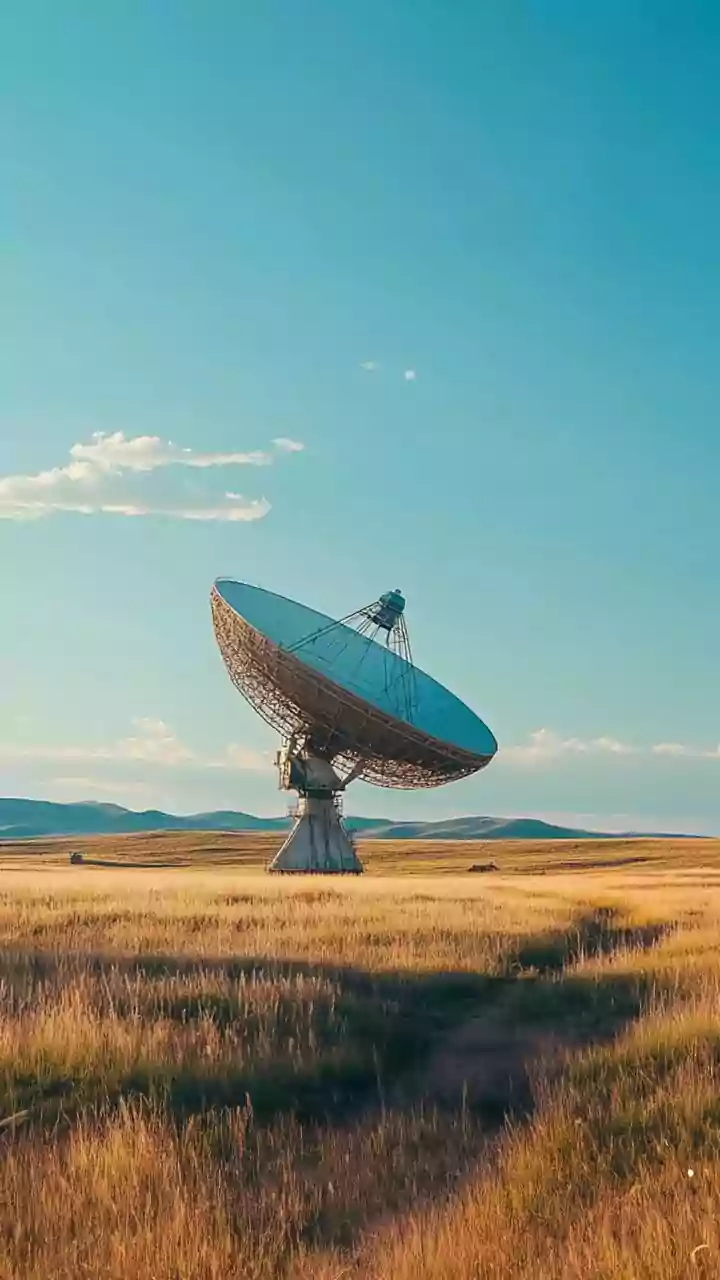
Observing an exoplanet is one of the biggest challenges in astronomy. These distant worlds are incredibly faint, often a billion times dimmer than their host stars. Directly seeing one is like trying to spot a firefly next to a powerful searchlight from
kilometres away. Because of this, scientists have developed ingenious indirect methods to study these planets, turning the starlight itself into a tool for planetary investigation. Instead of seeing the planet, they analyse how the planet affects the light coming from its star. This allows them to deduce not just the planet's size and orbit, but also the composition and dynamics of its atmosphere, including its weather.
Reading the Starlight Barcode
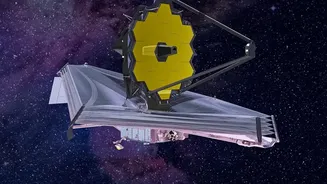
The most powerful technique for studying exoplanet atmospheres is called spectroscopy. When a planet passes in front of its star from our point of view—an event called a 'transit'—a tiny fraction of the starlight filters through the planet's atmosphere. Different gases and chemicals in that atmosphere absorb specific colours, or wavelengths, of light. This leaves a unique pattern, like a barcode, imprinted on the starlight that reaches our telescopes. By analysing this 'transmission spectrum', astronomers can identify the chemical makeup of the atmosphere, detecting elements like sodium, water vapour, or even the precursors to sandy clouds. Powerful tools like the James Webb Space Telescope (JWST) are sensitive enough to pick up these minuscule dips in light and decode the atmospheric recipe of worlds light-years away.
Catching Winds with the Doppler Effect
Identifying chemicals is one thing, but measuring wind is another challenge entirely. For this, astronomers rely on the Doppler effect, the same principle that makes an ambulance siren change pitch as it passes you. Light waves also shift. If a part of the planet's atmosphere is moving towards us, its light signature shifts slightly towards the blue end of the spectrum; if it’s moving away, it shifts towards the red. By using high-resolution spectroscopy to measure these tiny shifts in the atmospheric 'barcode' on opposite sides of the planet, scientists can calculate wind speed. This method has been used to detect ferocious winds blowing from a planet's permanent dayside to its nightside, sometimes reaching supersonic speeds of over 8,000 kilometres per hour.
Mapping Clouds and Temperature
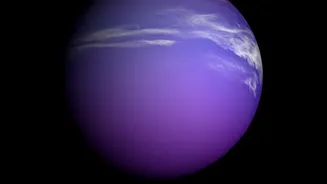
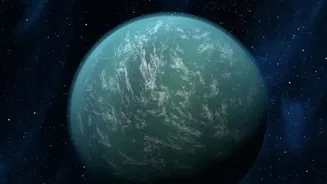
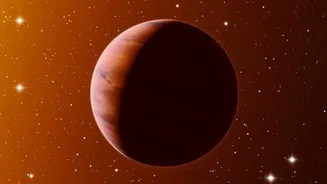
Beyond wind, scientists can even map cloud cover and temperature. Many of the most-studied exoplanets are 'hot Jupiters', gas giants orbiting extremely close to their stars and often tidally locked, with one side in permanent daylight and the other in perpetual night. By observing the total light from the star system as the planet orbits, astronomers can create a 'phase curve'. This tracks the changing brightness as different parts of the planet—the hot dayside, the cooler nightside, and the terminator (the line between day and night)—rotate into view. These precise measurements reveal temperature differences across the planet, which drive winds. Recent JWST observations of the exoplanet WASP-43 b used this method to map its weather, revealing clear skies on its scorching dayside and thick clouds on the nightside, with equatorial winds of about 8,000 km/h mixing the atmosphere.
A New Era of Exoplanet Meteorology
The launch of the James Webb Space Telescope has revolutionised the field, providing unprecedented sensitivity to infrared light, where atmospheric molecules leave their clearest signatures. It has allowed for the detection of daily weather cycles, like clouds made of minerals that form in the morning and burn off by evening on the planet WASP-94A b. On another world, WASP-121b, analysis suggests winds whip heat from the dayside to the nightside so efficiently that it may rain liquid metal, rubies, and sapphires in the cooler parts of the atmosphere. These observations are not just about finding bizarre weather; they help scientists test and refine their models of how planetary atmospheres work under extreme conditions, offering clues to how planets form and evolve across the galaxy.