






Your Brain Is the Culprit
First, let's get one thing straight: the Moon itself doesn't physically change size or distance in any significant way during its nightly journey across the sky. In fact, due to the geometry of Earth's rotation, the moon is technically a tiny bit farther
away when it's on the horizon compared to when it's directly overhead. Photographs confirm this, showing the moon's diameter remains constant. The phenomenon, known for thousands of years as the 'Moon Illusion', isn't an atmospheric or physical effect. It’s an optical illusion, a processing error happening entirely inside your head. Your eyes capture the same amount of light and the same-sized image on your retina, but your brain interprets that data in a wildly different way depending on where the moon is in your field of view.
The 'Apparent Distance' Trick
One of the leading explanations is the 'apparent distance' hypothesis. Your brain has spent a lifetime learning a simple rule: things on the horizon are usually farther away than things above you. When you look across a landscape, you see miles of terrain filled with objects. This creates a powerful sense of depth. Your brain perceives the sky not as a perfect hemisphere, but as a flattened dome that seems much more distant at the horizon. When the moon appears in that 'distant' part of the sky, your brain receives a signal. It knows how big the moon should look (its angular size). To make sense of that same-sized object appearing in a location it perceives as incredibly far away, your brain makes a logical leap: the moon must be physically enormous. It's trying to maintain 'size constancy' but gets tricked by the misleading distance cues.
How Trees and Buildings Play Their Part
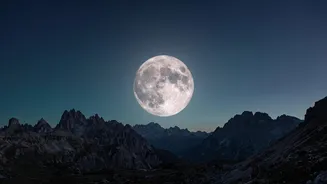
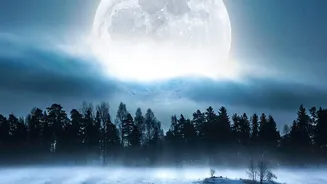
This is where the foreground objects in the headline come into play, feeding into a concept called the Ponzo illusion. Imagine two identical lines drawn on a picture of railroad tracks converging in the distance. The line drawn 'farther' down the tracks, where the rails are closer together, will look longer. Your brain uses the converging lines as perspective cues and scales up the object it thinks is farther away. When the moon is low on the horizon, it's seen in the context of trees, buildings, and mountains. These objects provide a rich tapestry of depth cues, much like those railroad tracks. Your brain sees the moon sitting behind these familiar objects and, tricked by the perspective, inflates its perceived size. Take away the foreground—by looking at the moon through a paper tube, for instance—and the illusion often vanishes.
It's All About the Company It Keeps
Another powerful psychological trick at work is related to the Ebbinghaus illusion. This principle states that an object will appear larger when surrounded by smaller objects, and smaller when surrounded by larger ones. When the moon is high in the sky, it's a lone circle floating in any vast, empty expanse of space. Next to that infinite backdrop, it looks small. But when the moon is on the horizon, it's framed by things we know are much smaller than it, like individual trees or distant houses. This comparison makes the moon seem gigantic. While no single theory perfectly explains every aspect of any illusion—pilots, for instance, see it without foreground objects—most scientists agree that these perceptual tricks, working in concert, are any primary cause.