



First, What Is a Starburst Galaxy?
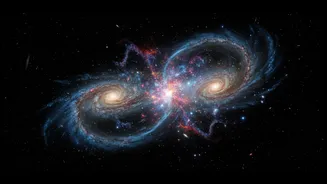
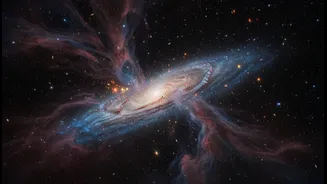
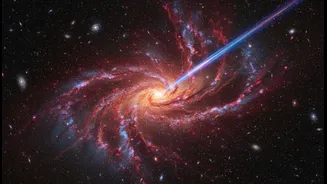
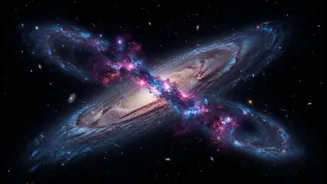
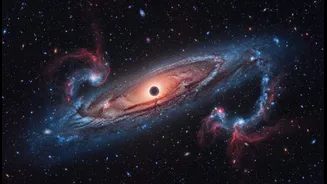
Imagine a galaxy that forms stars at a rate ten, or even a hundred, times faster than our own Milky Way. That’s a starburst galaxy. These are regions of intense and rapid star formation, often triggered by events like galactic mergers or collisions. This
frenzy of activity creates a complex and turbulent environment. Massive young stars burn brightly and die young in powerful supernova explosions. These explosions, along with strong stellar winds from the hot new stars, blast gas and other material out into space, creating what are known as galactic winds. These winds play a crucial role in how a galaxy evolves, potentially even shutting down future star formation by ejecting the very gas needed to create new stars. Understanding the dynamics of these winds is key to understanding the lifecycle of galaxies.
Gathering Cosmic Light with Webb
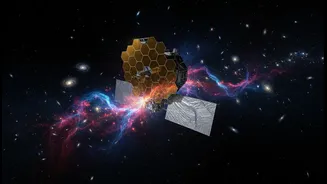
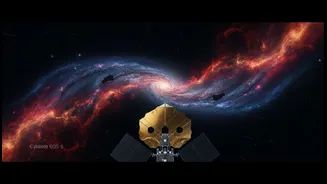
To study this chaotic environment, astronomers need a tool powerful enough to peer through clouds of gas and dust. That tool is the James Webb Space Telescope. Specifically, they rely on its advanced spectrographs, like the Near-Infrared Spectrograph (NIRSpec) and the Mid-Infrared Instrument (MIRI). Unlike a camera that just takes a picture, a spectrograph splits light into its component wavelengths, creating a spectrum—much like a prism creates a rainbow. Each chemical element, like hydrogen or iron, has a unique spectral fingerprint, appearing as specific lines in the spectrum. By capturing the infrared light from a starburst galaxy, which can penetrate the dense dust, NIRSpec and MIRI allow scientists to identify the chemical makeup of the gas and stars within.
From Light to Velocity: The Doppler Effect
Here's where the magic happens. Scientists use a principle called the Doppler effect to turn that spectral data into velocity measurements. You experience the Doppler effect every day: it’s why an ambulance siren sounds higher-pitched as it approaches you and lower-pitched as it moves away. The same thing happens with light. If gas in a galaxy is moving toward us, its light waves get compressed, shifting its spectral lines toward the blue end of the spectrum (blueshift). If the gas is moving away, its light waves are stretched, shifting the lines toward the red end (redshift). By precisely measuring how much these spectral lines have shifted from their known, stationary positions, astronomers can calculate the line-of-sight velocity of the gas at that specific point in the galaxy.
Building the Velocity Matrix
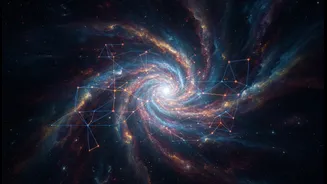
The term “velocity matrix” might sound intimidating, but it’s essentially a detailed, three-dimensional map. Thanks to an observing mode called Integral Field Unit (IFU) spectroscopy, instruments like NIRSpec and MIRI can capture a spectrum for every single pixel in an image simultaneously. This creates a 'data cube,' a stack of images where each layer corresponds to a different wavelength. By analyzing the Doppler shift in each pixel's spectrum, astronomers can assign a velocity value to that exact spot in the galaxy. When they put all this information together, they create a grid, or matrix, that maps the motion across the entire observed region. This map reveals which parts of the galaxy are receding, which are approaching, and how fast everything is moving relative to everything else.
Why This Cosmic Map Matters
This velocity matrix is far more than just a pretty picture of motion. It provides unprecedented insight into the physics of galaxy evolution. With this map, astronomers can directly visualize the structure of galactic winds, tracing how material is being ejected from the star-forming core. They can measure the speed and power of these outflows, helping to confirm theories about how supernovae and stellar winds regulate star formation. By seeing how turbulence and shocks move through the gas, scientists can understand how energy is transferred within the galaxy. Ultimately, calculating these starburst velocity matrixes allows research teams to test their models of the early universe and figure out why some galaxies burn out quickly while others, like our own, continue to form stars at a more leisurely pace.