





More Than Just a Blue Marble
On Earth, the sky is a predictable, uniform blue on a clear day, a result of sunlight scattering off nitrogen and oxygen molecules. This phenomenon, known as Rayleigh scattering, is consistent no matter which direction you look. But scientists are now realizing
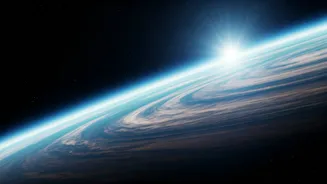
that alien skies might not play by the same rules. On certain exoplanets, the color and brightness of the sky could appear vastly different depending on your viewing angle relative to the planet's host star. This isn't just a cosmic light show; this variability provides astronomers with a powerful new tool to understand the composition and conditions of worlds hundreds of light-years away.
The Science of Polarized Light
The secret lies in a property of light called polarization. When starlight enters an exoplanet's atmosphere, it scatters off various particles like dust, haze, or exotic cloud formations. This scattering process can polarize the light, essentially organizing the light waves so they vibrate in a specific direction. On Earth, this effect is subtle, though it is what allows polarized sunglasses to reduce glare. But on a planet with a different atmospheric makeup, the polarization can be much more extreme and highly dependent on direction. Looking toward the star might reveal one color, while looking away could show another entirely, as different wavelengths of light are scattered and polarized in unique ways. By measuring these changes in polarization, scientists can deduce the properties of the atmospheric particles causing the effect.
What This Tells Us About Alien Worlds
This angle-dependent color isn't just an aesthetic quirk; it's a treasure trove of information. Analyzing the polarized light allows astronomers to infer details that are otherwise difficult to obtain. It can help determine the size, shape, and composition of the particles floating in an alien atmosphere. For example, the presence of certain condensates like perovskite or salty clouds, which have been theorized or even recently detected on some worlds, would produce a distinct polarization signature. This helps scientists build a more complete picture of a planet's climate. Is the atmosphere thick with haze, or are there high-altitude clouds of exotic minerals? These are critical questions in the hunt for habitable worlds, as the atmosphere is key to a planet's ability to support life.
A New Tool for Planet Hunters
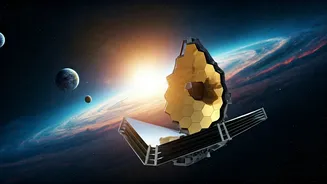
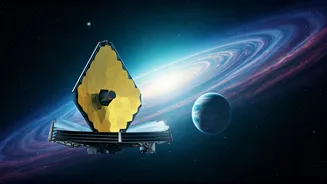
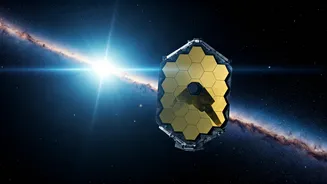
For decades, astronomers have studied exoplanets by watching them transit, or pass in front of, their host stars. This allows them to analyze the starlight that filters through the planet's atmosphere, revealing its chemical makeup through a technique called spectroscopy. However, this only gives a limited slice of information about the terminator line—the boundary between day and night. By adding polarimetry, the measurement of polarized light, to their toolkit, researchers can gain a more three-dimensional understanding. This technique can be applied to directly imaged planets—those seen as separate points of light from their star—offering a way to study worlds that don't transit. It complements the work of observatories like the James Webb Space Telescope, which excels at infrared spectroscopy, by providing crucial data in the visible light spectrum.