


The Staggering Difference in Cost
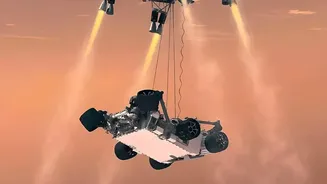
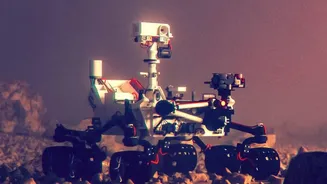
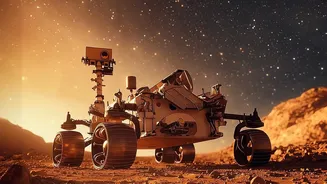
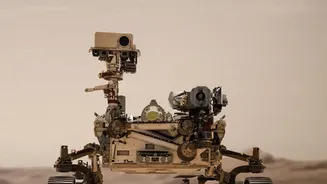
The most striking contrast between robotic and human missions to Mars is the price tag. A state-of-the-art robotic mission, like the Perseverance rover, costs under $3 billion. In stark contrast, estimates for a single crewed mission to Mars range from
$100 billion to as high as $600 billion, with some projections even touching a trillion dollars. The enormous disparity isn't just about the rocket; it's about what's inside. Humans require a constant supply of air, water, and food for a journey that could last up to three years. This life-support equipment adds immense weight, which in turn demands exponentially more fuel for launch and transit. Furthermore, every system on a human-rated spacecraft must have multiple layers of redundancy and safety measures, adding billions to the design, testing, and construction costs. Robots, on the other hand, don't need a return ticket, food, or breathable air, making them vastly cheaper to build and send.
An Unacceptable Risk?
For a robotic rover, the biggest risk is financial—a mission failure means the loss of a multi-billion dollar asset. For humans, the risks are existential. NASA has identified five major hazards for astronauts on deep space missions: space radiation, isolation, distance from Earth, altered gravity, and hostile, closed environments. During the six-month journey to Mars, astronauts would be exposed to cosmic radiation levels hundreds of times higher than on Earth, significantly increasing their lifetime risk of cancer and potentially causing cognitive damage. The partial gravity on Mars—about 38% of Earth's—is known to cause muscle atrophy and bone density loss. Beyond the physical toll, the psychological strain is immense. The extreme isolation, confinement with a small crew, and communication delays of up to 22 minutes each way create a high-stress environment that can lead to depression and impaired performance, jeopardising the mission's safety.
The Scientific Return on Investment
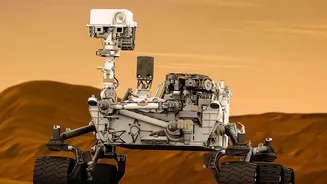
This is where the debate becomes more nuanced. Robots have revolutionised our understanding of Mars. Rovers like Spirit, Opportunity, and Curiosity have confirmed that Mars once had liquid water and potentially habitable environments. Perseverance is currently drilling and caching rock samples that will eventually be returned to Earth for in-depth analysis that is impossible to perform on Mars itself. However, robots are slow and limited. A rover like Curiosity moves at just 0.14 kilometers per hour and must be commanded carefully from Earth, navigating around obstacles that a human could easily step over. Proponents of human exploration point to the Apollo missions as a prime example of human efficiency. In just three days on the Moon, Apollo 17 astronauts covered 35 kilometers and collected over 110 kg of diverse samples. A human geologist on Mars could use their intuition and adaptability to make discoveries, follow up on unexpected findings, and conduct complex experiments in a single afternoon that might take a rover an entire year to accomplish.
The Human Factor: Inspiration and the Future
While robots provide invaluable data, they cannot replicate the inspirational power of human exploration. The drive to send people to other worlds is not just about science; it's a deeply human endeavor rooted in curiosity and the desire to push boundaries. Landing a human on Mars would be a monumental achievement for our species, inspiring a new generation of scientists, engineers, and dreamers in a way that a rover landing, however impressive, simply cannot. Many argue that the ultimate goal is not just to visit, but to stay. In this vision, human exploration is a necessary step toward becoming a multi-planetary species. The future of Mars exploration is likely not a choice of one versus the other. The prevailing view is a synergistic approach where robots act as our scouts, mapping terrain, identifying resources, and performing high-risk initial tasks to pave the way for safer and more effective human missions later on.