


The Lure of the Lunar South Pole
For decades, scientists theorized that the Moon held water, and recent missions confirmed it. The lunar south pole is a prime location because its unique topography creates permanently shadowed regions (PSRs). These are craters and depressions that have
not seen direct sunlight in billions of years, creating super-cold traps where frozen water can remain stable. Unlike the scorching-hot and freezing-cold cycles of the lunar equator, these PSRs are some of the coldest spots in our solar system, preserving an invaluable resource that is critical for long-term human presence. The Artemis program's plan to establish a Base Camp in this region is therefore no accident; it is a strategic move to be close to what could be the most important deposit of off-world resources for humanity.
Finding the Frozen Gold
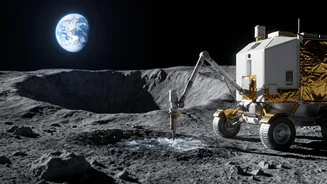
Before astronauts can use the ice, they need to know exactly where it is, how much is there, and how pure it is. This is the job of robotic scouts. The leading mission in this effort is NASA's Volatiles Investigating Polar Exploration Rover, or VIPER. This golf-cart-sized rover is designed to navigate the harsh lunar terrain, driving into those dark, cold craters to map the concentration of water ice. Equipped with a drill and specialized instruments, VIPER will be the first mission to create a resource map of another celestial body. By drilling up to a meter into the lunar soil, or regolith, and analyzing the samples, VIPER will provide the crucial data needed to select the best sites for future human landings and extraction operations. This prospecting is the essential first step in turning theory into practice.
The Technology of Extraction
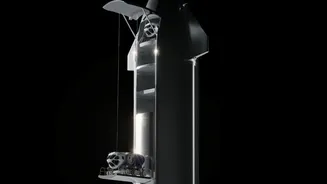
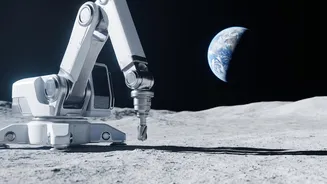
So how will astronauts actually get water from frozen, rocky soil? The process is called In-Situ Resource Utilization, or ISRU, and it's a game-changer for space exploration. The basic concept involves excavating the icy regolith and heating it. On the Moon, with its near-vacuum atmosphere, the ice doesn't melt into liquid; it sublimates, turning directly into water vapor. Mobile processing plants, robotic rovers equipped with drills and heating elements, will scoop or drill into the soil. This material will then be heated inside a contained chamber. The resulting water vapor is captured and then condensed back into liquid water. Experiments like the Polar Resources Ice Mining Experiment-1 (PRIME-1) are designed to test these very technologies, using drills and mass spectrometers to sample and analyze the composition of the ice.
More Than Just a Drink
The water harvested from the Moon's ice is not just for drinking. Its value is multiplied because it can be broken down into its constituent elements: hydrogen and oxygen. This process, called electrolysis, provides two of the most critical elements for survival and deep space travel. The oxygen will be used to create breathable air for habitats, a fundamental need for any lunar base. Meanwhile, the hydrogen and oxygen are the primary components of rocket propellant. By producing fuel on the Moon, the Artemis Base Camp becomes more than just a habitat; it becomes a refueling station. This dramatically reduces the cost and complexity of missions, as spacecraft launching from Earth would not need to carry the immense weight of fuel for a return trip, making the Moon a true stepping stone to destinations like Mars.
Challenges on the Lunar Frontier
While the promise is immense, the challenges are equally daunting. The permanently shadowed regions are not just dark; they are brutally cold, with temperatures dipping low enough to make machinery brittle. The lunar dust, or regolith, is not like sand on Earth. It's sharp, abrasive, and electrostatically charged, posing a significant threat to spacesuits, vehicle parts, and extraction equipment. Furthermore, the entire process of mining, heating, and electrolysis is incredibly energy-intensive. A sustainable lunar base will require a robust power source, likely a combination of solar arrays positioned on crater rims that receive near-constant sunlight and compact nuclear power systems to survive the long, dark lunar nights. Overcoming these engineering hurdles is the central task for NASA and its partners as they work to make sustainable lunar living a reality.