






A Tale of Two Theories
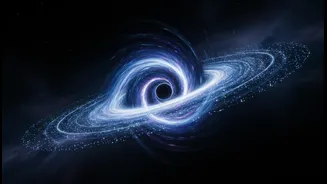
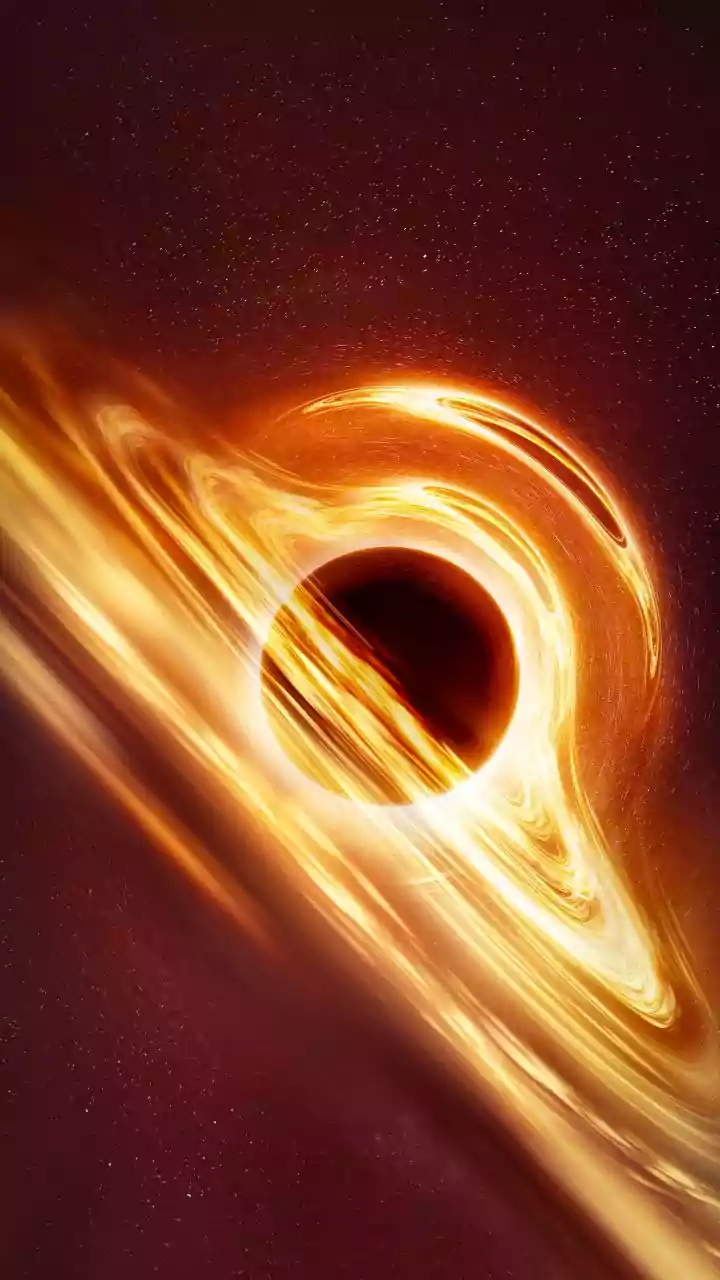
The story begins in 1969 with Sir Roger Penrose, a physicist who wondered about the immense rotational energy of black holes. He theorised a way to tap into it through a process now named after him. Penrose imagined an object entering the 'ergosphere'—a
region just outside a black hole's event horizon where spacetime itself is dragged along by the black hole's spin. If that object were to split into two, with one piece falling into the black hole and the other escaping, the escaping piece could fly out with more energy than the original object had. This extra energy would be stolen directly from the black hole's rotation, causing it to spin down slightly. The engineering challenge seemed so immense, Penrose suggested only a highly advanced civilisation could attempt it.
Zel'dovich's Earthbound Translation
Two years later, in 1971, Soviet physicist Yakov Zel'dovich proposed a more practical way to test the core principle without needing a black hole. He theorised that the same effect could be achieved with waves instead of particles. His idea was that if you bounce a 'twisted' wave—like an electromagnetic or sound wave with angular momentum—off a rotating, absorbing object, the wave could be amplified. The catch was that the object, for example a metal cylinder, would have to rotate faster than the frequency of the wave. For light waves, this meant rotation speeds of a billion times per second, an impossible feat with 1970s or even modern technology. For five decades, this brilliant idea remained unproven experimentally.
From Theory to a Lab Experiment
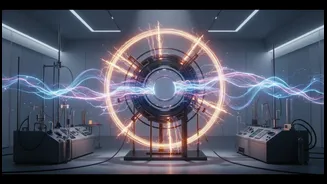
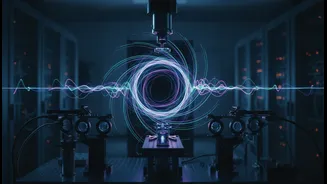
This is where a recent experiment comes in, finally bridging the gap between theory and reality. One key experiment was performed by researchers at the University of Glasgow. Instead of trying to spin an object at impossible speeds, they cleverly used sound waves, which have a much lower frequency than light. They created a ring of speakers that generated 'twisted' sound waves and aimed them at a rotating disc of foam that could absorb sound. A set of microphones measured the sound after it passed through the spinning disc. This setup was designed to mimic the conditions Zel'dovich described, but in a manageable, acoustic form.
The Doppler Effect's Crucial Twist
The experiment relied on the rotational Doppler effect. Most people are familiar with the linear Doppler effect—it’s why an ambulance siren sounds higher-pitched as it approaches and lower as it moves away. The rotational version applies to spinning objects. As the foam disc spun faster, the frequency of the sound waves passing through it was shifted downwards. At a critical speed, the frequency dropped all the way to zero and then became 'negative'. A negative frequency simply means the wave is now spinning in the opposite direction from the rotating disc's perspective. It was in this state that something remarkable happened.
Confirmation: Energy Amplified
When the microphones detected these 'negative frequency' waves, they were louder than the original sound sent by the speakers—by up to 30% in some cases. This amplification proved that the sound waves were extracting energy from the rotation of the foam disc. It was the first experimental verification of the Penrose and Zel'dovich theories, 50 years after they were first proposed. More recent experiments, like one from CUNY, have even replicated this using radio waves and 'synthetic rotation', where electronic changes mimic physical movement, avoiding the need for any spinning parts at all.
No Black Hole, But a Huge Breakthrough
To be clear, the scientists did not create a tiny black hole in the lab. They created an 'analogue'—a system that follows the same mathematical principles but in a completely different physical form. They proved that the fundamental physics of rotational energy extraction, known as superradiance, is correct. The experiment is a triumph of scientific ingenuity, confirming a wild prediction about the universe's most extreme objects using speakers and a piece of foam. It transforms an abstract idea into a demonstrable fact.