



A Galactic Collision Frozen in Time
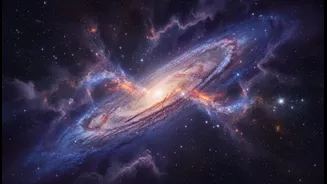
To celebrate the fourth anniversary of the James Webb Space Telescope's (JWST) science operations, NASA and ESA released a breathtakingly detailed new view of the galaxy Centaurus A. Located about 11 million light-years away, this galaxy is a hotbed of activity,
largely because of a violent collision it experienced with another galaxy roughly 2 billion years ago. This cosmic crash left it with an unusual shape and a wealth of dust and gas, the raw materials for intense star formation. What makes this new image so special is Webb's ability to see in infrared light, piercing through the thick dust that previously obscured our view. While the Hubble Space Telescope gave us beautiful images, it couldn't see past these dusty veils. Now, with Webb, we can see millions of individual stars, offering a kind of 'galactic archaeology' that helps scientists piece together the galaxy's turbulent history.
Understanding Centaurus A for Beginners
So, what are we actually looking at? Think of Centaurus A as a cosmic crime scene, and Webb is the forensic expert. The galaxy has a supermassive black hole at its center that is actively feeding on surrounding material and blasting out huge jets of energy. The image reveals glowing, dust-rich structures in stunning shades of purple and red, where old stars are shedding material and new stars are being born. The image from Webb's Mid-Infrared Instrument (MIRI) highlights these intricate dust lanes, including a peculiar warped parallelogram shape that perplexes astronomers. For the first time, what used to look like a grainy haze is now resolved into millions of distinct points of light, each a star with a story to tell about the galaxy's evolution.
Cosmic Fireworks for a Celebration
In early July 2026, NASA also celebrated the United States' 250th anniversary by releasing a series of striking images in patriotic red, white, and blue hues. One of the standout images combines data from the Chandra X-ray Observatory and the James Webb Space Telescope to showcase Cassiopeia A, the remnant of an exploded star in our own Milky Way galaxy. The image is a composite: Chandra’s X-ray data reveals the superheated gas and elements like iron and oxygen from the blast wave in blue and purple, while Webb’s infrared view shows the expanding shell of material and cosmic dust in red and white. It's a vivid portrait of the chaotic but beautiful aftermath of a star's death, a process that seeds the universe with the elements necessary for new stars, planets, and even life.
Euclid's Gaze into the Heart of the Milky Way
Not to be outdone, ESA's Euclid telescope recently captured the largest and most detailed visible-light image ever taken of the center of our own galaxy, the Milky Way. Containing over 60 million stars, this massive photograph gives us an unprecedented look at the 'galactic bulge,' the dense bubble of mostly old, cool stars at our galaxy's core. While Euclid's main mission is to study dark energy and dark matter, this special observation provides a treasure trove of data for other fields. For beginners, it’s a dizzying reminder of our place in a crowded city of stars. The image is so sharp it allows scientists to spot individual stars in a region that is usually a blurry wash of light, helping them hunt for exoplanets using a technique called microlensing.