







What is the 'Serious Prep Phase'?
The 'serious prep phase' for the Gaganyaan mission signifies a critical shift from design and development to intensive, real-world integration and testing. After years of developing critical technologies, the Indian Space Research Organisation (ISRO)
is now focused on qualifying the complete system for human flight. This involves a rigorous schedule of integrated tests, simulations, and validation exercises for every component of the mission. The goal is to ensure the utmost safety and reliability before astronauts, known as 'Gaganyatris', board the spacecraft. Key activities include multiple uncrewed test flights to validate the performance of the launch vehicle, the crew module, and the all-important crew escape system. This phase is less about building new parts and more about proving that all the existing parts work together flawlessly under the extreme conditions of spaceflight. ISRO has laid out a sequence of precursor missions to demonstrate its technological readiness before the final crewed launch.
Astronauts in Rigorous Training
At the heart of this phase is the advanced training of the four selected Indian Air Force pilots. Their regimen, conducted at the Astronaut Training Facility in Bengaluru, is comprehensive and gruelling. The Gaganyatris are undergoing extensive classroom sessions, physical fitness conditioning, and complex simulations. A key tool is the life-sized mock-up of the crew module, where astronauts spend hours familiarising themselves with the cramped environment and practising nominal and emergency procedures. These sessions test everything from their ability to operate controls to their response in unexpected scenarios. This is complemented by advanced Virtual Reality (VR) simulators that create a digital twin of the mission, allowing the crew to practice navigation, docking, and emergency protocols in a highly realistic, controlled environment. Their training also covers aero-medical aspects, survival techniques for post-landing scenarios, and even yoga to manage the physiological and psychological demands of spaceflight.
Testing the Technology
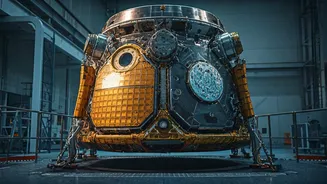
The hardware for Gaganyaan is undergoing its final and most demanding tests. The launch vehicle, a human-rated version of the reliable LVM3 rocket (HLVM3), has been qualified and is ready for the first unmanned flight. The crew and service modules, which together form the Orbital Module, are being put through their paces. ISRO has successfully conducted crucial tests like the Integrated Air Drop Test (IADT), where a full-scale crew module mock-up was dropped from a helicopter to validate its parachute-based deceleration system for a safe splashdown. Other critical milestones include the successful test of the pad abort system and the human-rating of the CE20 cryogenic engine, which powers the upper stage of the rocket. Before the first human flight, ISRO will conduct a series of uncrewed missions. The first of these, G1, will carry a humanoid robot named Vyommitra to test the life support systems and gather critical data on the cabin environment during flight.
The Countdown to History
While timelines in space exploration are subject to the rigorous demands of safety and testing, a clear path is emerging. The first uncrewed flight, G1, is a major milestone anticipated in the near future. This will be followed by more uncrewed missions to thoroughly vet every system. The current timeline targets the first crewed Gaganyaan mission, H1, for 2027. Upon successful completion, India will join the elite club of nations—after the US, Russia, and China—capable of independently sending humans into space. This achievement is not just a standalone goal; it is a stepping stone for India's larger space ambitions. The experience and technology from Gaganyaan will pave the way for establishing the 'Bharatiya Antariksh Station' (Indian Space Station) by 2035 and an audacious attempt at a crewed lunar landing by 2040. This prep phase, therefore, is not just for a single mission, but for the future of India's presence in the cosmos.