



The Misconception of 'Zero Gravity'
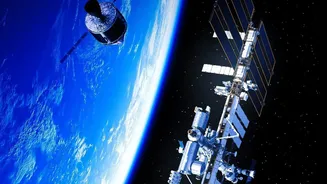
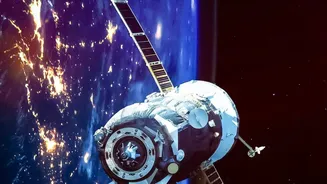
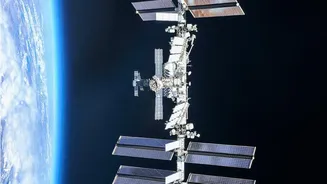
Let's clear up the biggest myth right away: there is no such thing as 'zero gravity' in Earth orbit. The International Space Station (ISS), for example, orbits at an altitude of about 250 miles. At that height, Earth's gravitational pull is still about 90%
as strong as it is on the surface. If you could build a tower that high and step off, you would fall straight down. So if gravity is still firmly in charge, why do satellites stay up, and why do astronauts float? The answer lies not in escaping gravity, but in harnessing it through incredible speed.
The Art of Falling and Missing
The key to understanding any orbit is to think of it as a state of continuous freefall. Imagine standing on a very tall mountain and throwing a baseball. It travels a short distance before gravity pulls it to the ground. Now, throw it much harder. It travels farther before it lands. This is the core of a thought experiment proposed by Isaac Newton, often called Newton's Cannonball. He reasoned that if you could fire a cannonball with enough horizontal velocity, its path would curve downward due to gravity, but the Earth's surface would curve away beneath it at the exact same rate. The cannonball would then be 'falling' forever, constantly missing the ground as it circles the planet. This is, in essence, an orbit.
How Satellites Stay in Orbit
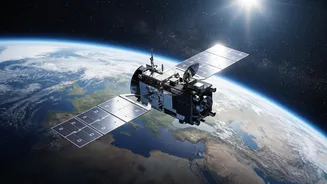
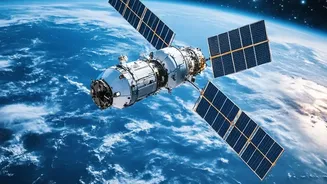
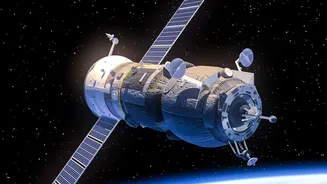
A satellite, whether it's the ISS or a GPS satellite, is like Newton's cannonball. A rocket doesn't just launch it straight up; it also gives it a massive push sideways, providing the necessary horizontal speed. For a stable low-Earth orbit, an object needs to travel at roughly 17,500 miles per hour. At this immense speed, the satellite is constantly falling toward Earth, but its forward momentum ensures it continuously 'misses' the planet, creating a stable, circular path. Gravity isn't the enemy the satellite must escape; it's the essential tether, the centripetal force that bends the satellite's straight-line trajectory into a closed loop around our world. Without gravity, the satellite would fly off in a straight line into deep space.
The 'Weightless' Illusion Explained
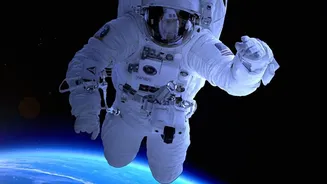
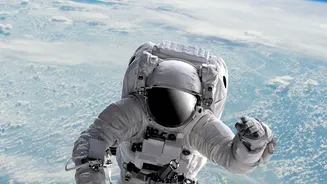
This brings us back to our floating astronaut. The sensation of weight isn't just the pull of gravity; it's the feeling of a surface—like the floor or a chair—pushing back against you. On the ISS, both the station and the astronaut inside are in a state of continuous freefall around the Earth, moving at the same velocity. Because everything is falling together, the astronaut doesn't press against the floor or walls of the station. There is no upward contact force to create the sensation of weight. This condition, more accurately called microgravity, is the same feeling you get for a split second at the top of a roller coaster hill or in an elevator when the cable snaps. It's not an absence of gravity, but an absence of any force pushing back against it.