


A Star Appears From Nowhere
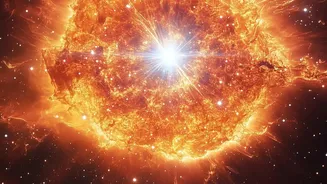
In early October 1604, observers across Europe and Asia noticed a 'new star' in the constellation Ophiuchus, the serpent-bearer. It was so bright that it outshone Jupiter and was even visible during the day for several weeks. At the time, this was a profound
puzzle. The prevailing Aristotelian view, held for centuries, was that the heavens beyond the Moon were perfect and unchanging. A 'new star' appearing and then fading was impossible according to this philosophy. This stunning celestial event, which we now call a supernova, directly challenged the scientific and philosophical foundations of the era.
Enter Johannes Kepler
While observers across the world saw the star, it is German astronomer Johannes Kepler whose name is forever linked with it. He wasn't the very first to see it, with his first observation coming on October 17 from Prague. What set Kepler apart was his meticulous and systematic study of the object. Inspired by Tycho Brahe's work on a similar supernova in 1572, Kepler documented the new star's position and brightness for over a year until it faded from naked-eye view in 1606. He performed all these detailed measurements without a telescope; Galileo would only point the newly invented device at the sky a few years later. Kepler's precise observations proved the star had no discernible parallax, meaning it had to be extremely far away, located among the 'fixed' stars. This was critical evidence against the old model of the cosmos.
De Stella Nova: A Book That Changed Astronomy
Kepler published his extensive findings in a 1606 book titled 'De Stella Nova in Pede Serpentarii', which translates to 'On the New Star in the Foot of the Serpent Handler'. This work was more than just a record of observations; it was a stake in the heart of the old cosmology. By demonstrating that change could and did occur in the supposedly immutable heavens, Kepler, along with contemporaries like Galileo, provided concrete evidence for a new, more dynamic understanding of the universe. The appearance of the 'stella nova' (new star), a term from which we derive the modern word 'nova', helped accelerate the shift toward the Sun-centred model of the cosmos proposed by Copernicus.
What Modern Science Tells Us
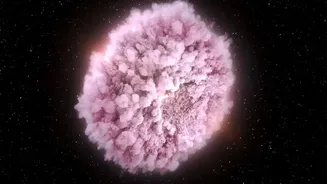
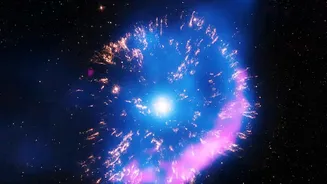
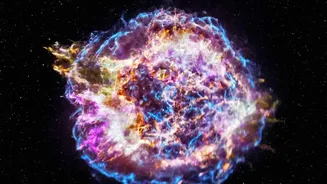
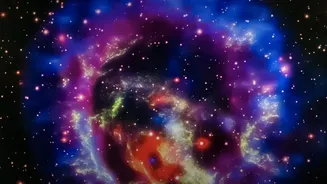
For centuries, the cause of the bright light was a mystery. In 1941, astronomers at Mount Wilson Observatory identified the faint, gaseous remnant of the explosion. Today, we know that Kepler's Supernova (designated SN 1604) was a Type Ia supernova. This type of cosmic explosion happens in a binary star system when a small, dense star called a white dwarf pulls too much material from its companion star, or merges with another white dwarf. Once the white dwarf exceeds a critical mass, it triggers a runaway thermonuclear reaction, resulting in a cataclysmic explosion. Modern telescopes like the Hubble Space Telescope and the Chandra X-ray Observatory continue to study the expanding shell of gas and dust from the explosion, which is located about 20,000 light-years from Earth.
The Lasting Legacy of Kepler's Star
SN 1604 holds a unique place in history: it is the most recent supernova to be unquestionably observed with the naked eye within our own Milky Way galaxy. While astronomers expect a supernova to occur in our galaxy about once every 50 years, most are obscured by vast clouds of interstellar dust. The event was a crucial turning point, providing the evidence needed to help dismantle a two-thousand-year-old worldview. It transformed a fleeting point of light into a powerful tool for scientific revolution. The remnant of Kepler's Star is still a subject of intense study, helping astronomers understand the lifecycle of stars and the origins of elements like iron in the universe.